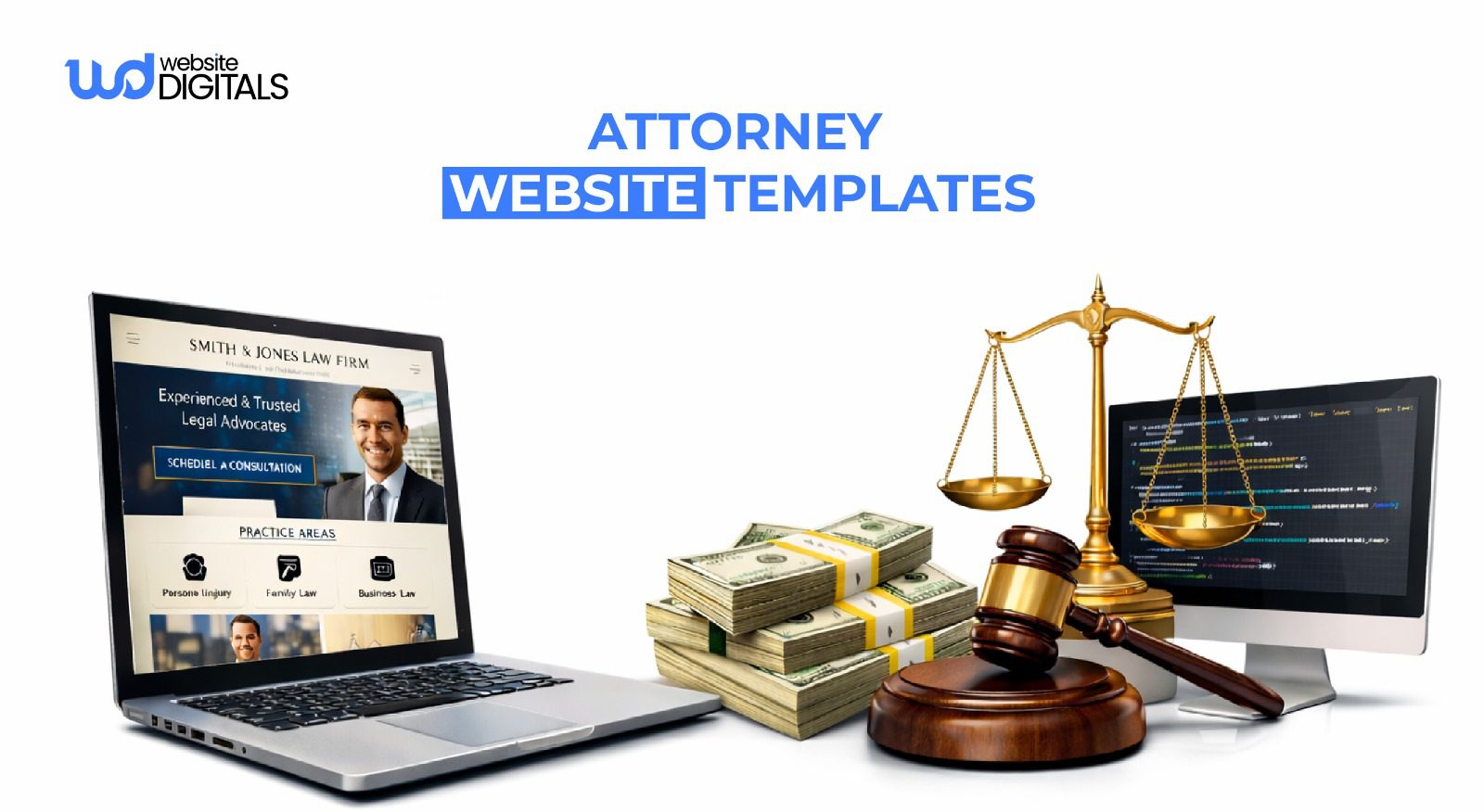
Why Attorney Website Templates Convert More High-Value Clients Than Expensive Custom Legal Sites
What if the website you spent months perfecting isn’t the one that actually brings in high-value clients?
Studies show 66% of attorney call conversions originate from organic search, proving performance matters more than custom aesthetics.
And while many firms wrestle with compliance requirements, credibility doubts, rising development costs, and slow custom builds, others are seeing faster results using attorney website templates built for speed and trust.
As Jeffrey Zeldman said,
“Design in the absence of content is not design; it’s decoration.”
This insight shows why design without performance falls flat, and why attorney website templates excel.
In this blog, we’ll reveal how they outperform costly custom sites and attract more high-value clients with less effort.
Key Takeaways
|

Where Custom Builds Fall Short
A custom legal website project sounds impressive on a whiteboard, but in practice, it often introduces friction points that actively deter serious clients.
Here’s where custom legal websites fall short:
1. Design Misalignment
Custom projects rely on a generalist web design company prioritizing aesthetics over the functional needs of the legal sector.
This lack of specialized insight results in a site that fails to build professional credibility.
They often miss the nuanced balance required on practice area pages, alienating potential clients.
2. Compliance Gaps
Legal advertising is heavily regulated.
A custom-built system by a generalist firm risks missing vital state bar compliance requirements, exposing the law firm to scrutiny.
High-quality attorney website templates are inherently compliance-ready, integrating necessary disclaimers and structures from the outset.
Real World Scenario:
|
A personal injury firm hires a generalist web design company to build a bespoke site. It starts looking beautiful, but a month later, the firm receives a warning from the state bar. Why? Missing required disclaimers, misleading phrasing, and improper placement of testimonials. The designer had no legal marketing experience. Meanwhile, a competing firm using a specialized attorney website template launches with built-in compliance language already in place, avoiding legal risk entirely. |
3. Unnecessary Complexity
Custom sites often add complex features (unique navigation, custom animations) to justify the high cost.
For a legal consumer, this complexity is a liability.
It slows down information retrieval, increasing friction and decreasing the likelihood of a high-stakes conversion.
Disclaimer:
|
And for firms not yet ready to hire responsive web design services, these complexities become even harder to maintain, update, and optimize. |
Note:
|
For high-value clients, complexity equals time wasted. They view a confusing website as a reflection of how difficult it will be to work with your firm. |
Real World Scenario:
|
Imagine a local electrician who skips an expensive custom site and launches quickly using electrician website templates built for service businesses. Within weeks, they have a fast, mobile-ready website that clearly showcases services and drives steady inquiries, outperforming competitors still waiting on long custom builds. The same advantage applies to law firms: industry-specific templates deliver speed, clarity, and conversions without the delays and complexity of custom development. |
What High-Value Clients Expect from a Law Firm Website
The decision-making process for hiring an attorney is rooted in high stakes and urgency. A potential client has a problem and needs a trustworthy solution now.
Understanding client expectations is critical, so here’s a closer look at what matters most to high-value prospects:
-
Clear Services
Clients want to instantly confirm that the firm handles their specific legal issue.
The navigation and practice area pages must be structured logically and instantly scannable, confirming expertise without delay.
-
Stable Experience
A slow-loading, buggy, or non-responsive site erodes trust instantly.
The site must be built with responsive design as a core principle, ensuring a flawless experience whether the client is using a desktop in their office or a mobile device in a waiting room.
This stability communicates competence and reliability.
-
Trust Indicators
The client needs proof that the firm is the best choice.
This includes:
- Visible contact information
- Clear attorney bio pages detailing relevant experience
- Genuine, professionally presented social proof
All components that are standardized and optimized in top-tier law firm website templates.
Why Custom Sites Miss the Mark on Conversion
The significant financial and time investment behind a custom website build rarely translates into stronger conversion rates. In many cases, it does the opposite. Here’s where they miss the mark:
1. Slow Timelines
A custom site can take anywhere from 6 to 12 months to build, leaving firms without a competitive online presence during that entire period.
That’s a year of lost law firm lead generation potential.
Switching to a professionally developed lawyer website template allows firms to go live quickly with a streamlined, high-converting design built to meet industry standards.
2. Buried Information
To maximize billable hours, custom developers often create elaborate, unique backend systems.
This makes simple content updates and the publishing of essential legal content pages slow and cumbersome.
Key information often gets buried under layers of custom code, frustrating both the law firm team and the client.
3. Update Bottlenecks
Every minor change, from updating a key employee’s attorney contact forms to implementing a small SEO fix, requires bringing the original, expensive developer back in.
This creates an update bottleneck, leaving the site static and vulnerable while costing the firm more money over time.
Why Proven Layouts Work Better for Legal Marketing
Top attorney website templates aren’t generic; they’re shaped by extensive A/B testing across successful law firms.
And here’s why they consistently outperform experimental custom designs: these proven layouts enhance usability, reduce friction, and ultimately drive stronger conversions:
-
Familiar Patterns
The legal consumer is often stressed and seeks immediate comfort and clarity.
A standard, clear layout, such as the familiar header, navigation, and service sections, provides a universal data-backed structure.
These familiar patterns minimize cognitive load, allowing prospective clients to focus instantly on the firm’s competence rather than site navigation.
-
Consistency Matters
A template enforces uniformity, ensuring consistency matters across all pages.
Uniformity in branding elements, CTA placements, and design reinforces the firm’s identity.
This predictability is vital for establishing and maintaining client trust.
-
Data-Backed Structure
The best law firm website templates are engineered based on conversion optimization principles specific to the legal sector.
They leverage proven placement strategies for critical elements like the phone number, intake forms, and testimonials to maximize the rate of qualified client inquiry.
Tips:
|
Look for templates that prominently feature an area for social proof (e.g., testimonials, awards) immediately below the fold on the homepage. This placement leverages the “recency effect” to build quick trust. |
How Templates Solve Core Issues for Law Firms
Choosing a template framework built specifically for the legal sector is a strategic business decision that lowers risk and accelerates return on investment.
-
Compliance Ready
As noted, a template designed by a legal marketing expert has legal disclaimers, bar association requirements, and state-specific advertising rules baked into the design, simplifying your compliance burden.
-
Built-In Credibility
Templates often feature pre-optimized sections for testimonials, case results, and key professional memberships.
They are designed to foreground the indicators that drive attorney reputation management, such as secure, compliant areas for secure client intake forms.
-
Lower Overall Cost
The initial cost of a premium, legal-focused template is a fraction of a custom build.
Furthermore, because these systems are based on common platforms like WordPress or HubSpot, future updates, maintenance, and expansions are cheaper, faster, and do not tie you to the original development firm.
The focus shifts from coding to content and branding.
Side-by-Side Breakdown: Custom Legal Website Build vs. Attorney Website Template
|
Feature |
Custom Legal Website Build |
Attorney Website Template |
|
Development Time |
6-12+ Months |
4-8 Weeks |
|
Initial Cost |
Very High ($20k – $100k+) |
Low to Moderate ($2k – $15k) |
|
Compliance/SEO |
Must be added/tested later |
Built-in, field-tested |
|
Load Speed |
Often Slow (due to custom code) |
Fast (optimized code base) |
|
Maintenance Dependency |
High dependency on the original firm |
Low dependency, standard platforms |
Conversion Features Templates Include
The true power of a specialized template lies in its pre-integrated conversion features.
-
Clear Hero Messaging:
An instant, above-the-fold statement of what the firm does, who they help, and what jurisdiction they serve.
-
Strong CTA Placement:
Clear, recurring calls to action (CTAs) are strategically placed to capture the client’s attention at every stage of the scrolling process.
-
Mobile-First Design:
Using modern responsive web design techniques keeps users engaged, essential when 57% of visitors won’t recommend a business with a poor mobile experience.
Performance Advantages Templates Offer
A template’s streamlined code base delivers tangible performance advantages.
- Faster Load Times: Less custom code and fewer bloated scripts result in dramatically faster load times, which is a critical Google ranking factor and a necessity for reducing client frustration.
- SEO-Friendly Setup: High-quality attorney website templates come with best-practice foundational SEO built in, including optimized title structures, clean code, and fast hosting prerequisites. This gives your law firm SEO efforts a head start over a slow, code-heavy custom site.
- Easy Adjustments: The intuitive nature of a template allows the firm or our team to make easy adjustments to content, imagery, and CTAs without requiring an advanced developer, enabling real-time optimization.
Why Templates Are a Smart Choice
In the high-stakes world of legal services, the goal of your website is not to win design awards; it is to generate qualified leads reliably and compliantly.
Investing in a tailored attorney website template framework is the clearest path to achieving this goal.
- Structure Over Novelty: Proven layouts win because they offer a reliable user experience that builds immediate trust.
- Clear Cost Comparison: The total cost of ownership (TOC) for a template-based site is significantly lower, freeing up budget for more valuable activities like lawyer marketing and targeted advertising.
- Reduced Risk: By inheriting a design structure that is already field-tested for compliance and conversion, you significantly reduce the risk of regulatory issues and poor performance.
Don’t spend tens of thousands of dollars and a year of lost revenue commissioning a custom build that may fail to meet the industry’s unique demands.
Instead, leverage a structure already proven to convert.
Focus your budget and time on what truly matters: providing stellar legal services and building a compelling content narrative within a high-performance framework.
Bonus Point:
|
Choosing a template allows you to shift your investment from generic code development to highly targeted content that addresses client pain points directly, which is the true driver of high-value conversions. |
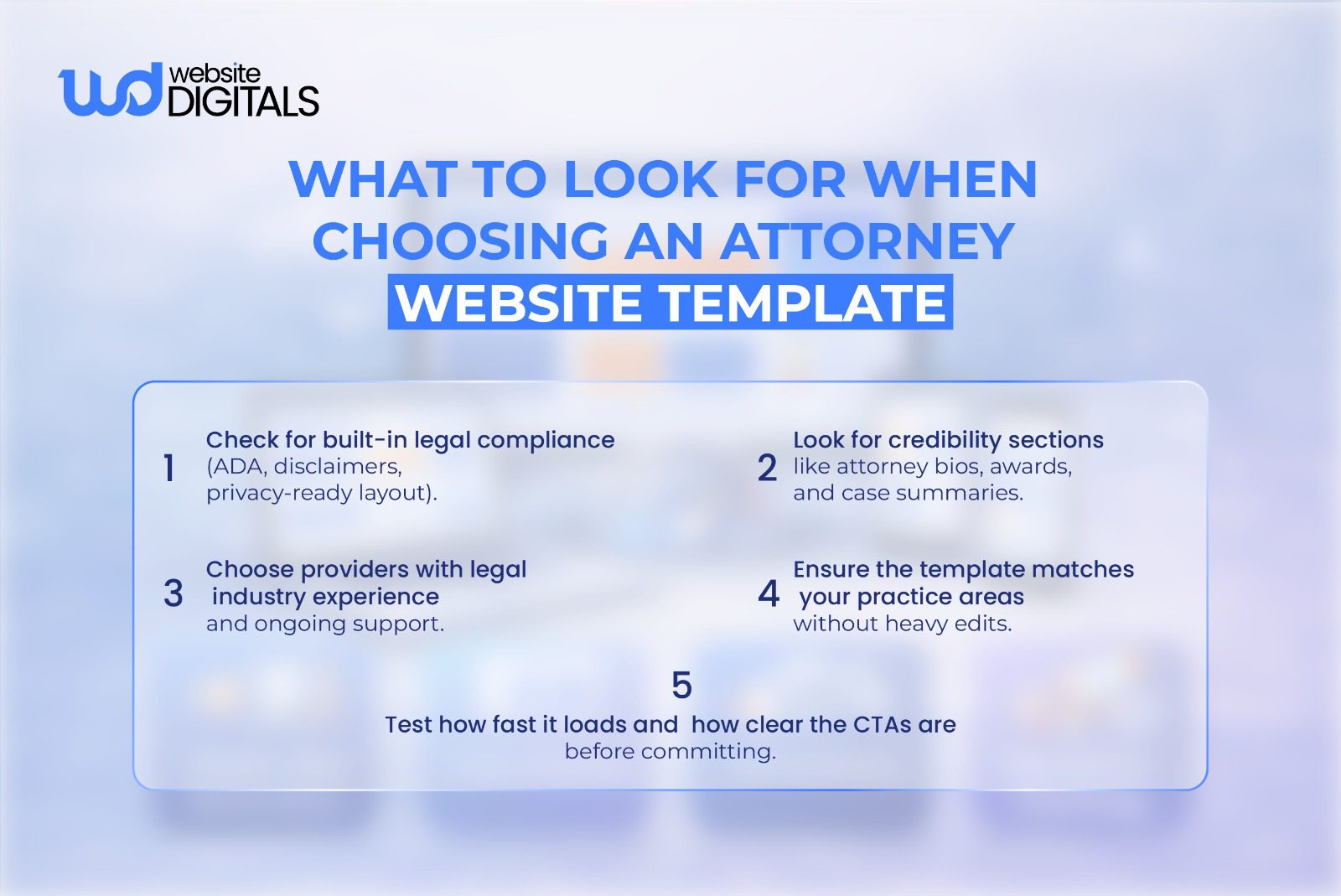
Wrapping It Up – Choose the Template or the Team Behind It
In the end, the real choice isn’t just between custom builds and attorney website templates, it’s between slow, uncertain development and a responsive web design system created by experts who understand legal compliance, credibility, and conversion.
A premium template is more than a structure; it’s the strategy, experience, and performance mindset of the legal marketing team behind it.
So, if you’re ready to elevate your law firm’s online presence with a responsive web design that’s built to convert, our experts at Website Digitals are here to help.
Reach out anytime at info@websitedigitals.com or call (646)-222-3598 to get started.
FAQs
How does Website Digitals help law firms choose the right attorney website templates?
Website Digitals guides law firms through selecting attorney website templates that match their practice areas, compliance needs, branding style, and conversion goals.
Why should a law firm hire Website Digitals for responsive web design services?
Website Digitals specializes in legal industry design, ensuring fast, compliant, mobile-first sites built to convert through proven, high-performing layouts.
What makes a good attorney website?
A good attorney website is fast, easy to navigate, mobile-friendly, and built around trust indicators like practice area clarity, attorney bio pages, and visible contact options.
Where can I find the best attorney website design examples?
You can find the best attorney website design examples by exploring legal marketing platforms, template libraries, or reviewing top-ranking law firm websites in your practice area.
How do I choose the right law firm website template?
Choose a law firm website template that aligns with your practice areas, supports responsive design, includes compliance-ready layouts, and offers strong conversion-focused features.
What should a lawyer website include?
A lawyer website should include clear services, attorney bio pages, practice area pages, client testimonials, secure intake forms, and straightforward calls to action.
How do attorney website templates work?
Attorney website templates work by giving law firms a pre-optimized framework with built-in design, SEO, compliance, and UX structures that can be customized quickly.
What are the key features of a good law firm website?
A good law firm website features fast load speed, strong branding, responsive web design, clear navigation, and conversion elements like attorney contact forms and visible CTAs.