Nextjs CMS Advanced Strategies for Enterprise-Grade Web Development
Most enterprises aren’t struggling with content creation, they’re struggling with content delivery.
Marketing wants faster publishing. Developers want cleaner workflows. Compliance wants zero risk.
Legacy CMS platforms force teams to choose between speed and control.
Next.js CMS architectures remove that tradeoff.
By separating content from presentation, enterprises gain flexibility without losing governance.
In this guide, we’ll break down how to use Next.js with headless CMS platforms to build systems that move fast, scale globally, and stay compliant.
Key Takeaways
- How Next.js CMS eliminates enterprise bottlenecks in scalability and security.
- Proven architectural blueprints for composable, globally distributed CMS ecosystems.
- Real-world case studies showing measurable performance and governance gains.
- A step-by-step enterprise roadmap from pilot to production.
Why Enterprises Are Shifting to Composable Architectures
Traditional CMS platforms like WordPress and Drupal once powered enterprise websites, but in today’s cloud-first, multi-region environment, they struggle to deliver the flexibility and performance enterprises need.
Composable architectures, built with Next.js CMS, empower organizations to create modular, API-driven digital ecosystems that evolve quickly without disrupting existing systems.
This approach lets teams innovate faster, deploy with confidence, and maintain governance at scale.
Why This Shift Matters
- JAMstack and API-first ecosystems promote modular, reusable components that make scaling and integration seamless.
- Headless CMS solutions enable true omnichannel delivery, from websites to mobile apps to IoT, while improving governance and localization workflows.
- Modern deployment pipelines powered by Next.js deliver content globally in near real time through incremental builds and edge rendering.
According to Strapi’s 2025 Headless CMS Insights Report, 73% of businesses have already adopted headless CMS architectures, marking a 14% increase since 2021.
This surge highlights how composable and headless systems have become central to enterprise digital strategies.
Key Insight
Composable CMS architectures reduce time to market by decoupling the front end from the back end. This separation gives developers more autonomy to release features independently, while marketers gain flexibility to update content instantly without technical dependencies.
Understanding Next.js as the Foundation of Enterprise-Scale CMS
Next.js Core Capabilities for CMS Integration
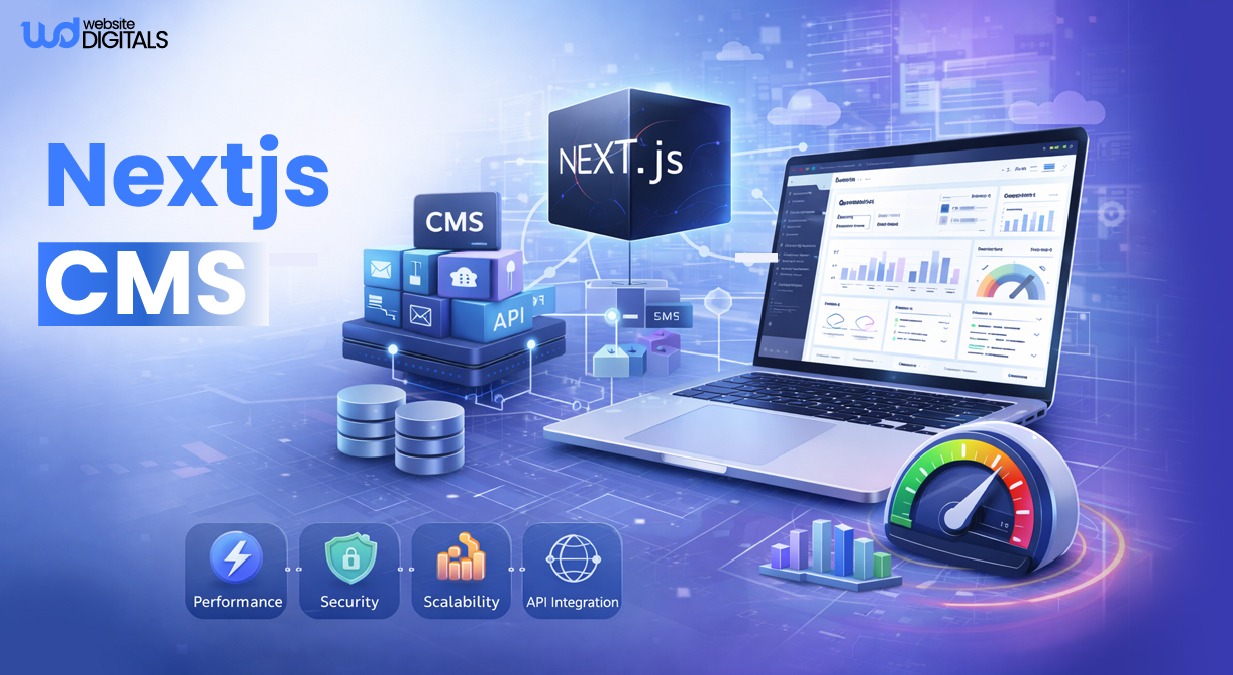
Next.js is not just another React framework. It serves as the foundation for enterprise-grade web performance and scalability.
Its flexible architecture supports complex content operations, making it ideal for Next.js CMS integration in modern organizations.
- Incremental Static Regeneration (ISR): Regenerate only updated pages instead of rebuilding the entire site.
- Hybrid SSR + SSG: Combine server-side rendering and static generation for optimal performance and SEO.
- Edge Functions and Middleware: Deliver fast, personalized experiences closer to global users.
- App Router and Route Handlers: Simplify data fetching and improve API flexibility.
- TypeScript Integration: Ensure long-term maintainability and type-safe development at scale.
Together, these features make Next.js CMS a reliable, high-performance framework for enterprises that demand both speed and governance control.
The Role of a Headless CMS in Modern Enterprises
A headless CMS acts as the organization’s central content hub, providing structured data via APIs to multiple front-end channels. With Next.js managing presentation and caching, enterprises can deliver consistent digital experiences across regions and devices.
Platforms like Strapi, Sanity, Payload, and Contentful integrate seamlessly with Next.js, supporting localization, versioning, and multi-team collaboration.
Key Challenges in Enterprise CMS Implementations
Scalability Across Teams and Regions
Enterprise CMS environments must support hundreds of editors, multiple brands, and distributed teams. To achieve this, organizations should implement:
- Multi-tenant architectures for isolated brand or regional environments.
- Branching and version control to manage parallel content workflows.
- CI/CD pipelines for automated content previews and deployment validation.
Security and Compliance
Security and compliance are non-negotiable for enterprise content management. To maintain data integrity and protect access:
- Implement role-based access control (RBAC).
- Use identity management tools such as Auth0 or Microsoft Entra ID (Azure AD).
- Enable audit logs and encryption at rest to comply with SOC 2 and GDPR requirements.
Performance and Global Delivery
Enterprises rely on Vercel Edge Network or Cloudflare CDN to distribute content worldwide with minimal latency. Next.js App Router enhances data fetching and rendering efficiency, keeping Core Web Vitals within performance benchmarks.
Real-World Scenario: A global SaaS platform reported a 32% faster average page load time after migrating from a legacy frontend to a Next.js CMS architecture using Incremental Static Regeneration (ISR) and CDN caching.
Note: Always track improvements using Google Core Web Vitals metrics. These directly affect both SEO ranking and user satisfaction.
Advanced Next.js CMS Strategies for Enterprises
Once your architecture is composable, it’s time to elevate performance, automation, and personalization. The following strategies will help enterprises optimize their Next.js CMS for scalability, speed, and security.
1. Building a Composable Architecture
Unify multiple APIs into a single, maintainable data layer using GraphQL or REST.
- Integrate product, marketing, and localization sources.
- Adopt a content mesh approach to ensure flexibility and modularity.
- Use schema validation tools to enforce consistency across teams.
2. Leveraging ISR and Edge Rendering for Personalization
Personalization should never compromise performance.
Incremental Static Regeneration (ISR) updates content as needed, while Edge Middleware delivers region-specific experiences with minimal latency.
Example: Pair Contentful with Next.js Middleware to serve tailored product recommendations for EU and US audiences within a single global build.
Tip: Implement regional consent gating to align personalization with GDPR and data privacy laws.
3. Integrating CMS Workflows into DevOps Pipelines
Treat content as code to streamline release management.
- Manage schema and configuration changes through Git-based versioning.
- Automate preview environments for editorial validation.
- Sync staging and production deployments through CI/CD pipelines.
Pro Tip: Mirror engineering QA workflows in your CMS by integrating approval stages and content testing before publishing.
4. Enterprise-Grade Security and Governance
Security is not a feature; it is an architectural principle.
- Use tokenized APIs and encrypted webhooks.
- Enforce CI/CD security policies including secret scanning and dependency validation.
- Implement NextAuth.js for secure authentication within a zero-trust framework.
Reference: NextAuth.js Documentation
5. Observability, Monitoring, and Performance Analytics
You cannot optimize what you do not measure.
- Use Datadog, New Relic, or Vercel Analytics to track real-time metrics.
- Monitor LCP, CLS, and INP (updated Core Web Vitals).
- Automate alerts for downtime, failed builds, or latency spikes.
Things to Consider:
- Align CMS releases with DevOps sprints.
- Test every integration under production-like load.
Pro Tip: Combine NextAuth.js with Edge Functions for secure, location-aware rendering.
Reference: Google Core Web Vitals Overview
Case Studies: How Enterprises Scale with Next.js CMS
Case Study 1: Global Retailer Migrates from Drupal
A leading global retailer rebuilt its e-commerce infrastructure using Next.js and a headless CMS to improve site performance and scalability.
According to Smashing Magazine’s enterprise migration case study, the company achieved:
- Up to 40% faster page load speeds compared to the legacy CMS.
- More consistent Core Web Vitals across regions.
- Simplified localization workflows for multi-region publishing.
Case Study 2: SaaS Enterprise Adopts Payload CMS + Next.js
A fast-scaling SaaS company modernized its monolithic setup by adopting Payload CMS with Next.js to manage content across 20+ markets.
As reported in Payload CMS case studies, this approach enabled:
- A 60–70% reduction in deployment time through Git-based workflows.
- Improved team autonomy via a schema-driven content model.
- Enhanced SEO performance and maintainability with ISR caching.
Case Study 3: Fintech Leader Implements Next.js for Secure Delivery
A financial services company leveraged Next.js and Edge Middleware for secure, low-latency content delivery to global clients.
Drawing from industry best practices shared in Daffodil Software’s Next.js for E-Commerce overview, the firm achieved:
- Full SOC 2 Type II alignment with zero downtime during releases.
- Improved regional performance using Edge-level encryption and RBAC controls.
- Faster rollout of secure content updates across distributed systems.
Key Insight
Aligning CMS schema design with enterprise data models early significantly reduces long-term maintenance costs and refactoring overhead during scaling.
Step-by-Step Enterprise Adoption Model
1. Discovery and Audit
Evaluate your existing CMS infrastructure to identify technical debt, performance bottlenecks, and content workflow inefficiencies.
Deliverable: Current-state audit report and benchmark data for Core Web Vitals.
2. Architecture Design
Select your preferred Next.js CMS (e.g., Contentful, Sanity, or Payload) and define your hybrid rendering strategy combining SSR, SSG, and ISR.
Include a preview environment using Draft Mode for editors and a caching plan for dynamic routes.
Deliverable: Reference architecture with rendering and caching blueprint.
3. Proof of Concept (PoC)
Validate ISR performance, real-time preview workflows, and region-based personalization.
Include data-privacy compliance (GDPR/CCPA) and consent-based personalization rules.
Deliverable: Functional prototype demonstrating editorial flow and latency benchmarks.
4. Scaling
Automate deployments through CI/CD, enable intelligent caching, and configure multi-region builds via Vercel or Cloudflare.
Adopt canary releases, feature flags, and rollback mechanisms to minimize risk.
Deliverable: Scalable production pipeline with rollback and monitoring safeguards.
5. Optimization and Monitoring
Establish observability dashboards, SLA metrics, and governance protocols.
Track LCP, CLS, and INP (Core Web Vitals) while monitoring uptime and cache hit ratios.
Deliverable: Performance dashboards with automated alerting and audit logs.
Common Pitfalls to Avoid
- Skipping preview and QA environments.
- Over-complicating CMS schema design.
- Neglecting edge caching or CDN tuning.
- Lacking rollback strategy or region-specific testing.
- Ignoring consent gating and data-residency rules.
Pre-Launch Check: Run stress and load tests before multi-region rollout; small issues can cascade into major outages at scale.
Final Thought
Next.js CMS is not just an upgrade; it’s the new standard for enterprise-grade web development.
Composable architecture, edge rendering, and intelligent caching bring the agility modern enterprises need.
If your CMS limits innovation, it’s time to go headless with Next.js because the future of enterprise content is modular, measurable, and fast.
Partner with Website Digitals, the experts in enterprise Next.js CMS development and integration. We help leading organizations streamline content workflows, boost performance, and build systems that scale effortlessly.
Call us today at (646) 222-3598, Email: info@yourcompany.com, Or simply Book a Free Strategy Session to explore how Next.js CMS can power your next generation of digital experiences.
Disclaimer: All strategies and examples are for educational purposes only. Validate all implementation details against your enterprise’s security, compliance, and data-residency requirements before deployment
Frequently Asked Questions
1. Why should enterprises choose Next.js with a headless CMS?
Next.js paired with a headless CMS provides exceptional performance, scalability, and flexibility. It allows enterprises to deploy content globally with faster load times, improved security, and full control over data delivery and user experience.
2. What are the top enterprise-ready CMS options for Next.js?
Enterprises typically choose platforms such as Contentful, Sanity, Strapi, Storyblok, or Payload. Each of these headless CMS solutions integrates smoothly with Next.js, offering API-first content delivery and strong support for composable architecture.
3. How does Incremental Static Regeneration (ISR) improve enterprise performance?
ISR allows pages to be updated automatically when content changes, without requiring a complete rebuild. This significantly reduces deployment time and enables enterprises to handle large-scale content updates efficiently while maintaining static-site performance.
4. How can enterprises ensure security and compliance in a Next.js CMS architecture?
Security and compliance can be maintained by using role-based access control, encrypted APIs, and regular internal audits. Incorporating NextAuth.js helps support zero-trust authentication, while secure CI/CD practices and governance policies reduce vulnerabilities.
5. What’s the role of GraphQL in Next.js CMS integrations?
GraphQL acts as a centralized layer that connects multiple data sources and delivers consistent queries to the Next.js front end. This makes content delivery faster, more reliable, and easier to manage across complex enterprise systems.
6. How do I migrate from a traditional CMS to a Next.js CMS stack?
The most effective approach is to follow a phased migration strategy. Begin by modeling your content and defining API connections, then move key pages into the new framework. Once tested for accuracy and stability, expand gradually until the legacy system can be retired.
7. How can enterprises optimize Next.js for multi-region deployment?
Optimization is achieved by distributing content through global edge networks such as Vercel, Cloudflare, or AWS CloudFront. This setup delivers localized content with minimal latency and ensures users in every region experience consistently high performance.
8. What’s the cost of implementing Next.js CMS at enterprise scale?
Implementation costs vary depending on CMS licensing, hosting infrastructure, and development resources. However, enterprises typically see a strong return on investment within months, as performance improvements lead to higher user engagement and operational efficiency.
9. How does Next.js CMS support personalization and A/B testing?
Next.js supports personalization through integrations with customer data platforms like Optimizely, Segment, or HubSpot. Edge functions make it possible to deliver content variations instantly, allowing enterprises to run experiments and tailor experiences for specific user segments.
10. What KPIs should enterprises measure to prove ROI from a Next.js CMS?
Key performance indicators include improvements in Core Web Vitals such as loading and interactivity, faster publishing cycles, higher conversion rates, and increased deployment frequency. These metrics demonstrate both the technical and business impact of the Next.js CMS architecture.
11. How does Next.js CMS impact SEO and discoverability?
Next.js supports hybrid rendering through server-side and static generation, which makes content easier for search engines to crawl and index. Combined with optimized Core Web Vitals and structured metadata, it helps enterprises achieve stronger search visibility and ranking stability.
12. Which teams should manage and maintain a Next.js CMS?
Successful implementation requires collaboration among engineering, content operations, and security teams. Engineering manages integrations and deployments, content operations handles editorial workflows, and security ensures compliance and governance across all environments.