Web Design for Mortgage Brands That Want More Leads Without More Ad Spend
Mortgage marketing is getting expensive, and rising CPCs and lead costs are hitting every lender’s bottom line.
Yet many mortgage brands face the same issue: their website isn’t converting the traffic they already pay for.
The truth is simple, most mortgage companies don’t have a traffic problem, they have a conversion problem. Borrowers are clicking your ads, but something in the funnel, trust, clarity, mobile UX, or forms, breaks their confidence and stops them from converting.
Before increasing your ad budget, ask yourself: is your website built to convert borrowers, or is it quietly killing your ROI?
In this guide, you’ll learn how web design for mortgage brokers can boost leads without spending more on traffic, using trust-driven UX, conversion-focused layouts, and frameworks top lenders rely on.
Key Takeaways
- High-performing user experience, clear messaging, and trust signals can significantly boost mortgage conversion rates.
- Multi-step forms, simplified fields, and strong calls to action (CTAs) help increase both lead volume and lead quality.
- Mobile speed, ADA accessibility, and a strong value proposition directly support higher mortgage lead generation.
- With the right web design framework for mortgage brokers, lenders can improve inbound leads without increasing Google Ads or social media ad spend.
The Hidden Revenue Leak in Mortgage Marketing
Why Your Mortgage Website, Not Your Ad Budget, Is the Real Problem
Most lenders chase traffic instead of fixing their conversion funnel, especially when they rely on basic mortgage website templates that aren’t built for conversion.
But traffic without conversion is wasted, especially in a high-CPC industry like mortgage lending. If you have ever wondered “why isn’t my mortgage website converting?”, the real issue often has nothing to do with your ads and everything to do with what happens after the click.
Many lenders overlook essential mortgage conversion funnel optimization techniques that directly affect how efficiently visitors move from landing pages to completed applications.
A mortgage website must support the full funnel, including:
- responsive mortgage website design
- secure mortgage lead capture forms
- NMLS-verified trust signals
- clear mortgage branding
Real-World Scenario
Imagine this: A lender increases their Google Ads budget by 22 percent. Traffic grows, but leads remain flat.
What went wrong?
The landing page has:
- an overwhelming, single long-form application
- no recognizable trust badges
- unclear messaging
- slow mobile load speed
Once the page was redesigned with a simple 3-step pre-qualification form, BBB trust badges, and improved mobile UX, conversions increased by 38 percent without raising ad spend. This example is not unique. Most mortgage websites lose leads because forms are too long, trust indicators are missing, or the mobile experience is weak.
The Cost of an Ineffective Website in 2025
According to WordStream’s latest Google Ads Benchmarks, average CPC across industries increased by about 13 % year-over-year, which means your budget now buys fewer clicks — making it essential for every click to convert effectively. (Source: WordStream Google Ads Benchmarks 2025)
Common conversion leaks include:
- slow mobile pages
- unclear CTAs
- missing rate-quote tools
- lack of trust indicators
- no ADA accessibility
Note: As ad costs rise every year, conversion rate optimization (CRO) becomes the only scalable and cost-efficient way to improve ROI. Strong web design for mortgage brokers gives lenders the advantage of increasing lead volume without increasing Google Ads or social media budgets.
Why High-Performing Mortgage Websites Convert Without More Traffic
The Mortgage Buyer Journey Has Changed
Modern mortgage borrowers compare multiple lenders online before deciding who to contact. This shift has increased the need for ongoing mortgage broker website optimization to keep user experience aligned with borrower expectations:
- transparency
- speed
- trust
- mobile-first design
- simple pre-qualification flows
Similar to the standards used in responsive web design services for law firms and other trust-based industries.
Many lenders now ask: “What do mortgage borrowers look for in a lender website?” The short answer is clarity, credibility, and ease.
Pro Tip: Use heatmaps to see where users stop scrolling. Most mortgage websites lose visitors within the top 35 percent of the page, long before they reach calls to action or rate tools.
The Science Behind Conversion-Driven Mortgage Web Design
Borrowers are more likely to convert when:
- the value proposition is clear
- trust is established immediately
- the process looks simple
- the perceived risk is low
Things to Consider
Compliance and trust elements play a critical role in conversion, especially in financial services. Key components include:
- NMLS verification
- mortgage disclosures
- ADA-compliant mortgage websites
- SSL-encrypted document uploads
- FHA and VA guideline considerations
These elements strengthen credibility and reduce friction, which directly increases conversion probability.
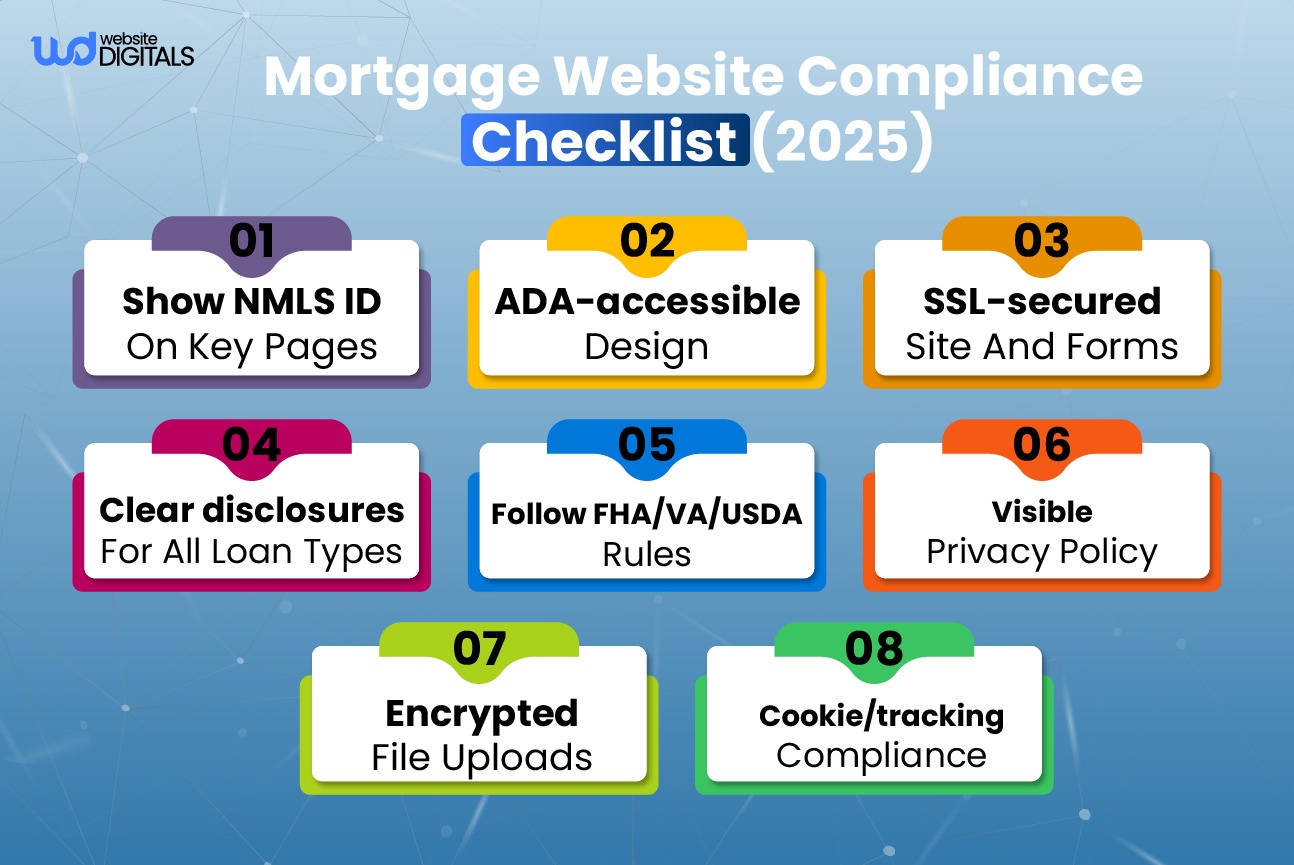
Alt Text: Checklist of 2025 mortgage website compliance requirements.
How Your Website Affects Lead Quality (Not Just Volume)
High-quality mortgage leads typically come from:
- smart form logic (conditional questions, auto-fill fields, progressive steps)
- segmented landing pages for FHA, VA, HELOC, and refi borrowers
- CRM automation through systems like Jungo, Velocify, and HubSpot
- instant follow-ups that respond within seconds
Bonus Point: Personalized mortgage landing pages can increase lead quality by 15 to 25 percent, especially when paired with CRM-driven personalization.
The Framework That Gets Mortgage Brands More Leads Without Bigger Budgets
Conversion-Boosting Design Elements Every Mortgage Website Must Have
1. Clear Value Proposition Above the Fold
Avoid jargon like “full-service mortgage solutions.”
Replace it with simple clarity such as: “Get mortgage options in minutes with no credit impact.”
Note: Above the fold is prime digital real estate. Use your strongest message here, not filler.
2. Trust Signals That Actually Improve Conversions
Borrowers want safety, credibility, and transparency. Include trust elements such as:
- NMLS ID
- BBB accreditation
- FHA/VA approval badges
- verified Google reviews
- local expertise indicators (for example, “Serving Arizona borrowers since 2008”)
Real-World Scenario
A mortgage lender added verified reviews and news features above the fold and saw a 27 percent increase in conversions.
These improvements also support loan officer web design standards by reinforcing personal credibility and professional transparency.
3. Conversion-Optimized Forms
Shorter forms are not always better, smarter forms are. Multi-step forms help:
- reduce friction
- improve completion rates
- qualify borrowers faster
Long Form vs. Multi-Step Form Performance
|
Feature |
Long Form |
Multi-Step Form |
|
Completion Rate |
Low |
High |
|
Abandon Rate |
High |
Low |
|
User Experience |
Overwhelming |
Easy |
|
Lead Quality |
Mixed |
Better |
|
Conversion Rate |
3–6% |
12–28% |
4. Speed, Mobile Experience & ADA Accessibility
Fast pages produce more conversions, and in some cases, using a modern architecture like a frontend for headless CMS can help lenders achieve significantly faster load times.
According to Google, a one-second delay in mobile page load can reduce conversions by up to 20%. (Source: Think with Google – Mobile Page Speed & Conversions)
Key Insight: ADA compliance improves trust, enhances usability, and supports accessibility on mobile devices, all critical for mortgage shoppers.
Real Examples: How Mortgage Brands Increased Leads Without Buying More Traffic
Case Study A: 35% Reduction in Form Drop-Off With Funnel Redesign
A mortgage brand achieved a 35% reduction in form abandonment after switching from a long, single-step form to a structured multi-step experience, resulting in a smoother path to completion. (Source: Blacksmith Agency Mortgage Case Study)
Case Study B: 75% Lower Mobile Bounce Rate With Landing Page Optimization
A redesigned mobile-first landing page combined with stronger trust indicators produced a 75% reduction in mobile bounce rate, dramatically improving funnel efficiency. (Source: BBMC Mortgage Case Study on Umbraco)
How to Transform Your Mortgage Website Into a Lead-Generation Machine
Step-by-Step Roadmap for Mortgage Marketing Teams
Step 1: Audit Your Current Funnel for Drop-Off Points
Look for:
- bounce hotspots
- form exits
- slow pages
- unclear messages
Conducting a detailed mortgage website performance audit can help reveal hidden friction points that impact conversions.
Things to Consider
- ADA compliance
- NMLS placement
- secure, encrypted forms
Step 2: Identify High-Intent Pages to Optimize
Your highest conversion opportunities include:
- FHA loan pages
- VA loan pages
- refinance pages
- first-time homebuyer pages
Step 3: Prioritize the 20% of Changes That Drive 80% of Results
Focus your optimization efforts on:
- forms
- CTAs
- above-the-fold clarity
- load speed
Step 4: Build Conversion-First Landing Pages for Every Loan Type
Borrowers don’t want generic information. Create targeted landing pages for:
- Jumbo
- HELOC
- USDA
- Conventional
Step 5: Integrate CRM and Automated Follow-Up Sequences
Response time impacts funding rates more than traffic volume.
Tools to support automation and tracking:
- Jungo
- Velocify
- HubSpot
- Encompass
KPI Dashboard: How Do You Measure Mortgage Website Performance?
Monitor key performance indicators such as:
- conversion rate
- cost per lead
- cost per funded loan
- form start rate
- call-to-form rate
- organic traffic growth
Bonus Tip: Quarterly conversion rate optimization reviews often lead to noticeably higher annual conversions.
When You’re Ready to Scale: Options for Mortgage Brands
- CRO audit
- landing page rebuild
- full website redesign
- support from a mortgage broker web design specialist
Disclaimer: Performance results can vary depending on borrower behavior, traffic quality, and lender compliance requirements.
Conclusion
Smart, conversion-focused web design for mortgage brokers remains one of the fastest and most cost-effective ways to increase leads without raising ad spend.
When your website is optimized for trust, speed, clarity, and simplicity, every marketing dollar stretches farther.
If your goal is to generate more funded loans, start by improving your website experience, not your ad budget.
Partner with Website Digitals the mortgage web design specialists. Call us at (646) 222-3598 or email info@websitedigitals.com to get started today.
Frequently Asked Questions:
1 How can web design improve lead quality, not just volume?
Web design improves lead quality by using multi-step pre-qualification forms, clear messaging, and segmented loan-type pages that filter visitors based on their needs. This helps attract borrowers who are ready to take action, not just casual browsers.
2 What design factors most influence mortgage conversion rates?
The biggest conversion drivers are fast page speed, clear value messaging, strong mobile UX, ADA accessibility, and trust signals like reviews and NMLS verification.
3 Do I need more traffic, or a better mortgage conversion funnel?
Most lenders also benefit from refining their overall mortgage digital marketing strategy to ensure their traffic acquisition aligns with a well-optimized website.
4 How long does a mortgage website redesign take?
A mortgage website redesign typically takes 4 to 12 weeks, depending on the number of pages, loan-type landing pages, integrations, and compliance requirements.
5 How much does a mortgage web redesign cost?
Most mortgage website redesigns cost $4,000 to $30,000, depending on customization, CRM integration, automation, and the level of compliance built into the design.
6 What integrations help mortgage lead generation the most?
Key integrations include Jungo, Velocify, HubSpot, and Encompass, which automate follow-ups, sync borrower data, and improve response time—one of the strongest predictors of lead-to-funding conversion.
7 Does ADA compliance help conversions?
Yes. ADA compliance improves conversions by enhancing trust, accessibility, and mobile usability, making your site easier to use for all borrowers.
8 What content builds trust with mortgage borrowers?
Borrowers trust websites with reviews, mortgage calculators, rate tools, educational guides, and clear explanations of loan programs. Transparent content reduces uncertainty and increases conversions.
9 How do I know if my website is hurting my ad ROI?
Your website may be hurting ROI if you see high bounce rates, slow load speed, low form-start rates, or poor engagement on key loan pages. These signals indicate that expensive clicks aren’t converting.
10 What mistakes do most mortgage websites make?
The most common mistakes include long or confusing forms, slow mobile performance, missing trust indicators, weak CTAs, and generic content that doesn’t match borrower intent.