7 Key Factors for Successful Enterprise Portal Development
Picture a typical morning inside a large enterprise.
A manager needs a quick update.
One piece of data is in the HR system. Another lives in finance. Project files are buried in shared drives, and approvals sit in someone’s inbox. Before any real work begins, teams are already switching tabs and chasing information.
This isn’t just frustrating; it slows decisions and drains productivity.
Research shows that organizations using too many fragmented apps experience 30% higher digital friction, leading to visible productivity loss and disengagement.
Enterprise portal development is meant to solve this by bringing everything into one place.
But many portals fail because they organize systems, not work. So what actually makes a portal effective?
In this blog, we’ll walk through the 7 key factors that help enterprises turn scattered tools into a connected, scalable digital workplace that teams actually rely on.
Key Takeaways
|
Is Your Enterprise Ready for a Scalable Portal Architecture?
Yes, if your teams rely on multiple logins, fragmented dashboards, and disconnected systems, your enterprise is ready for a scalable portal architecture.
When HR, finance, sales, operations, and leadership each work in separate tools, a basic intranet can only support the organization for so long.
As teams scale and data volume increases, these systems break down.
This is where enterprise portal development becomes a strategic necessity.
A modern enterprise portal replaces silos with a single access layer that unifies tools, data, and workflows into role-based dashboards.
It enables collaboration, workflow automation, and business process management, without forcing users to switch platforms.
If employees can’t instantly access the information they need, it’s a clear indicator that enterprise system modernization is required.
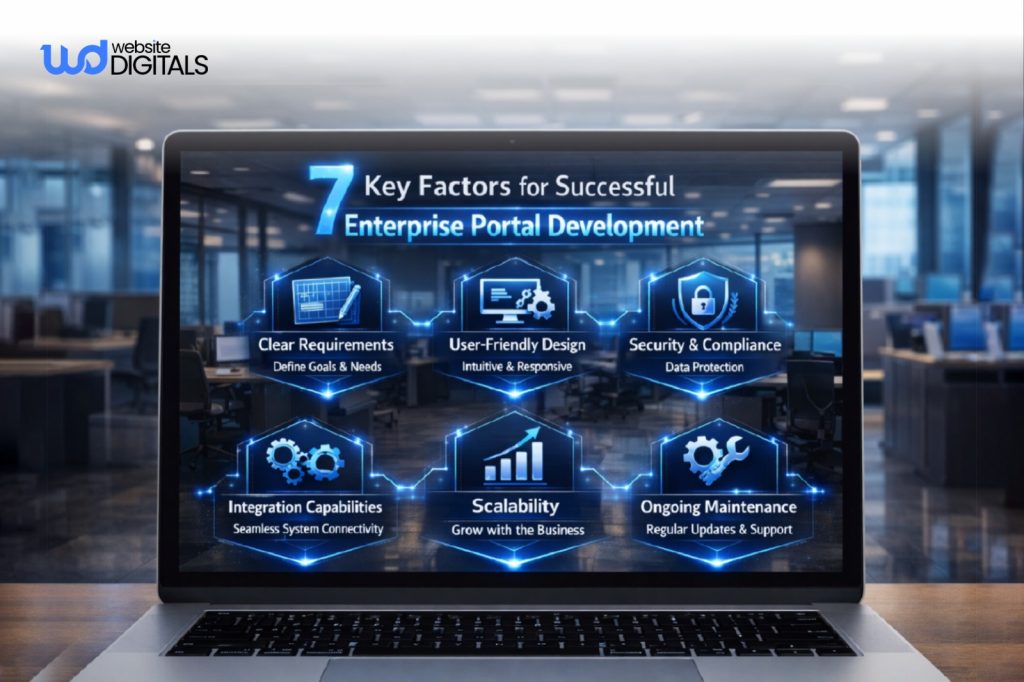
7 Factors That Define Successful Enterprise Portal Development
Factor #1: Scalability for Enterprise Growth
What works for 300 employees often breaks at 3,000.
Many organizations build portals that perform well at first, then slow down as teams grow, new offices open, or more data is added.
A scalable enterprise portal is designed to grow smoothly with the business, without needing a rebuild every few years, especially when supported by cloud-first approaches like Azure portal development.
Real-world scenario:
|
A global retail company launched an internal portal for its head office. When they expanded into new regions, the same portal handled thousands of additional users without disruption, because growth was planned from day one. |
Must Read: If your business is growing, your portal should grow with it, not hold it back.
Factor #2: Seamless System Integration
The true value of an enterprise portal is simplicity.
Employees shouldn’t have to jump between multiple tools to complete one task.
A successful portal pulls information together so teams see everything they need in one place: finance data, HR updates, documents, and workflows.
Real-world scenario:
|
A healthcare organization reduced internal delays by giving staff one portal to access schedules, documents, and approvals, cutting time wasted switching systems every day. |
Key idea: One portal, one view, fewer headaches.
Factor #3: Data Architecture and Governance
Without structure, portals become digital junk drawers.
When information isn’t organized properly, employees stop trusting the system. Important files get lost, outdated data circulates, and productivity drops.
A strong enterprise portal ensures information is organized, accurate, and easy to find, no matter where it comes from.
Must Read: If people can’t find what they need in seconds, the portal isn’t doing its job.
Factor #4: User-Centric Enterprise Design
There’s a dangerous myth in enterprise IT:
“Internal tools don’t need great design.”
In reality, poor user experience directly impacts productivity and slows teams down.
When an enterprise portal is confusing, slow, or frustrating, employees avoid using it or create workarounds that introduce security and compliance risks.
Strong enterprise UX design focuses on clarity, speed, and relevance.
Role-based dashboards show users only what they need, whether for internal operations or client portal development scenarios, reducing cognitive load and unnecessary actions.
The easier an enterprise portal is to use, the faster teams adopt workflow automation and achieve consistent internal process optimization.
Factor #5: Security, Access & Compliance
Security should protect people, not slow them down.
Employees expect secure access without jumping through hoops. A well-built portal lets users sign in once and only see what they’re allowed to see, nothing more, nothing less.
Clear access rules protect sensitive data while keeping everyday work smooth and efficient.
Note: Strong security works quietly in the background, without getting in the way.
Factor #6: Change Management and Adoption
Even the best portal fails if no one uses it.
Enterprise portal development is as much a people initiative as a technical one. Successful implementations include a clear change management strategy:
- Involving department leaders early
- Identifying real workflow pain points
- Providing practical training and documentation
- Showing teams how the portal improves their day-to-day work
Change matters: organizations that invest in thoughtful digital workplace strategies outperform peers and deliver higher productivity and ROI.
Note: Adoption comes when the portal solves real problems, not just stores systems.
Factor #7: Maintainability and Ownership
An enterprise portal is never “finished.”
As the business evolves, the portal must evolve with it, which is why many enterprises choose custom web development solutions over rigid, one-size-fits-all platforms.
New features, updates, and enhancements should be easy to introduce without disrupting day-to-day operations. Just as important is clear ownership. Someone must be accountable for keeping the portal aligned with business goals, whether that responsibility sits with an internal team or a long-term implementation partner.
Note: A portal should support the business for years, not become another system that needs replacing.
How to Measure Enterprise Portal Success
|
Measurement Area |
What to Track |
Why It Matters |
|
User Adoption |
Daily/monthly active users |
Shows whether employees actually use the portal |
|
Task Completion Time |
Time saved per workflow |
Measures productivity improvement |
|
Search Effectiveness |
Successful search rate |
Indicates data organization quality |
|
Workflow Usage |
Automated vs manual tasks |
Proves workflow automation impact |
|
Support Requests |
Portal-related tickets |
Highlights usability and UX gaps |
Wrapping It Up
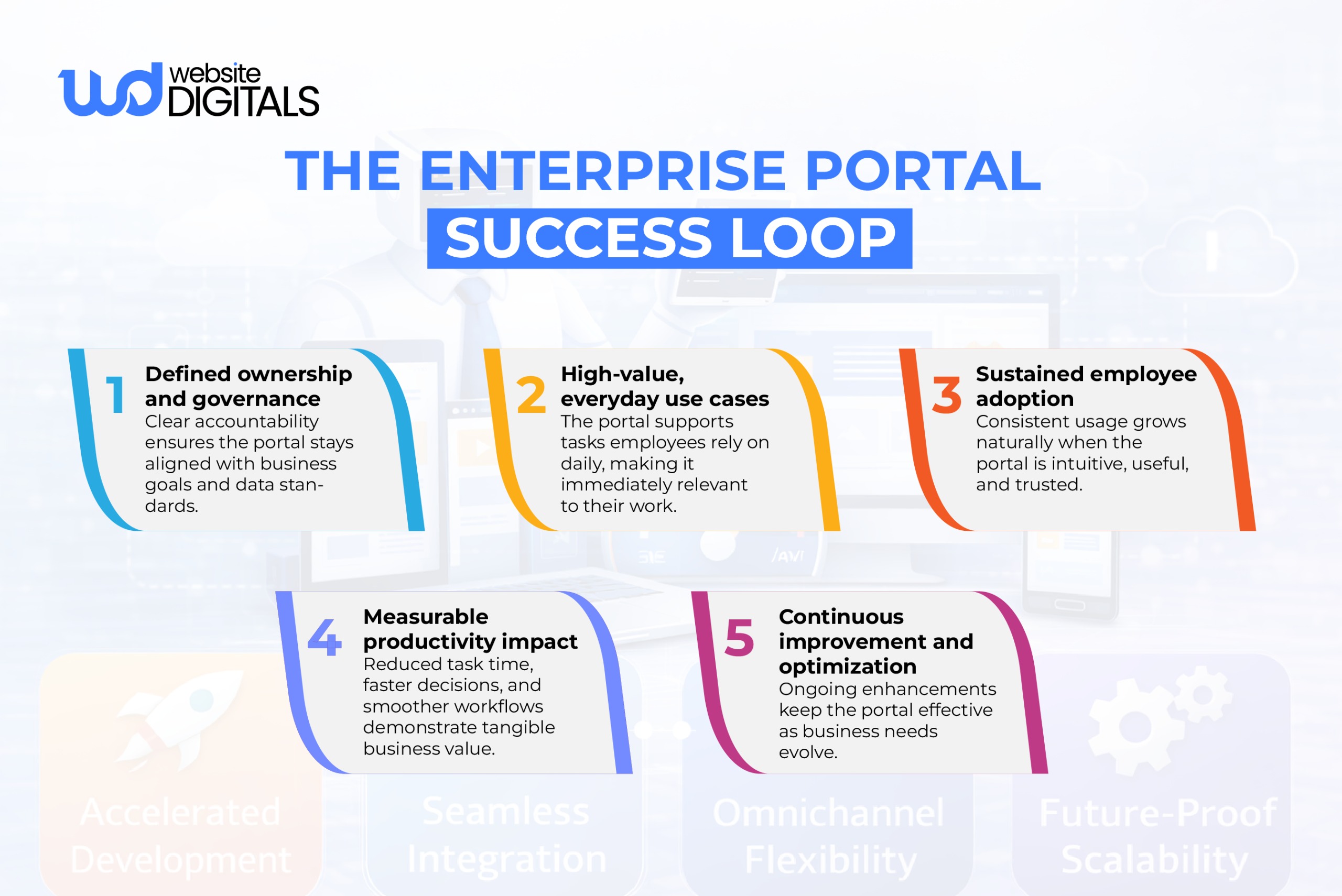
Enterprise portal development isn’t about launching yet another internal system. It’s about bringing order to complexity, connecting tools, data, and teams into one secure, scalable digital workplace.
When it’s done right, an enterprise portal becomes the backbone of how work actually gets done.
If your systems feel fragmented or difficult to manage, it may be time for a smarter approach. At Website Digitals, we help enterprises design and build portals that scale, integrate seamlessly, and are actually used by employees.
As a trusted enterprise web portal development company, our focus is on delivering portals that drive real, measurable business outcomes.
Want to explore what that could look like for your organization? Reach out to our experts at info@websitedigitals.com or call (646)-222-3598, and let’s talk about building a portal that truly works for your business.
FAQs
- Why should enterprises choose Website Digitals for enterprise portal development?
At Website Digitals, we specialize in enterprise portal development that scales with business growth, integrates seamlessly with existing systems, and drives real employee adoption, not just deployment.
- Does Website Digitals handle end-to-end enterprise portal development?
Yes. Website Digitals provides complete support, from strategy and architecture planning to custom development, system integration, and long-term optimization of enterprise portals.
- What is enterprise portal development?
Enterprise portal development is the process of building a centralized digital platform that connects employees, partners, and systems through role-based access, shared workflows, and unified data.
- How do enterprise portals work inside large organizations?
Enterprise portals work by acting as a single access layer, pulling data and tools from multiple systems so users can complete tasks, collaborate, and make decisions from one place.
- How is enterprise portal architecture structured?
Enterprise portal architecture is typically modular, allowing different systems, workflows, and content sources to connect while remaining flexible, scalable, and secure over time.
- What is the difference between an enterprise portal and an intranet?
An intranet mainly shares information, while an enterprise portal is interactive, supporting workflows, automation, integrations, and role-specific dashboards across departments.
- What are the benefits of enterprise portal systems?
Key benefits include improved collaboration, faster decision-making, reduced system silos, better data access, stronger security, and higher operational efficiency.
- What are enterprise portal best practices?
Enterprise portal best practices include focusing on scalability, clear access control, intuitive design, seamless system integration, and ongoing maintenance to support long-term business goals.