How Headless CMS for Ecommerce Enhances Content Control and Multi-Channel Strategies
Are you just frustrated with managing ecommerce content across multiple channels?
As an online business, delivering a seamless customer experience is vital.
Yet, it becomes challenging when content is spread across various platforms.
A flexible content management solution can be the reason for success for your ecommerce strategy.
By separating your content from your frontend, you gain control over how it’s presented and delivered.
This approach ensures a more streamlined and effective strategy.
This is where a headless CMS for ecommerce shines, a solution that lets you manage your ecommerce content in one place.
So, have a look.
Key Takeaways
- Understand how a headless CMS can improve ecommerce content management.
- Learn how to enhance content control and delivery across multiple channels.
- Discover the benefits of decoupling content from your frontend.
- Explore how a headless CMS can streamline your ecommerce strategy.
- Find out how to deliver a seamless customer experience across different platforms.
The Evolution of Content Management in Ecommerce
Ecommerce’s rapid growth highlights the critical need for efficient, flexible content management systems, especially for brands investing in custom ecommerce app development to deliver personalized shopping experiences.
The way businesses manage their content significantly influences their ability to provide seamless experiences across various channels.
Traditional CMS Limitations for Modern Ecommerce
- Traditional Content Management Systems (CMS) were not built to handle the complexities of today’s ecommerce.
- They often face performance bottlenecks and scaling challenges.
Performance Bottlenecks
- Traditional CMS can cause slow page loads and poor website performance.
- This negatively affects user experience and search engine rankings.
Scaling Challenges
As ecommerce businesses expand, traditional CMS struggle to manage increased traffic and content demands.
Soft Reminder: This hinders scalability.
The Shift Towards API-First Content Management
The shortcomings of traditional CMS have led to a shift towards API-first content management, a foundation that aligns perfectly with Next.js headless CMS development. This approach enables businesses to deliver content efficiently across multiple channels.
Omnichannel Requirements
- API-first content management allows for managing content from a single source.
- It delivers content seamlessly across web development, mobile, and social channels.
Developer Experience Improvements
- API-first CMS offers developers greater flexibility and control.
- This improves the development experience and enables faster content deployment.
Key Benefits of Headless CMS for Ecommerce Businesses
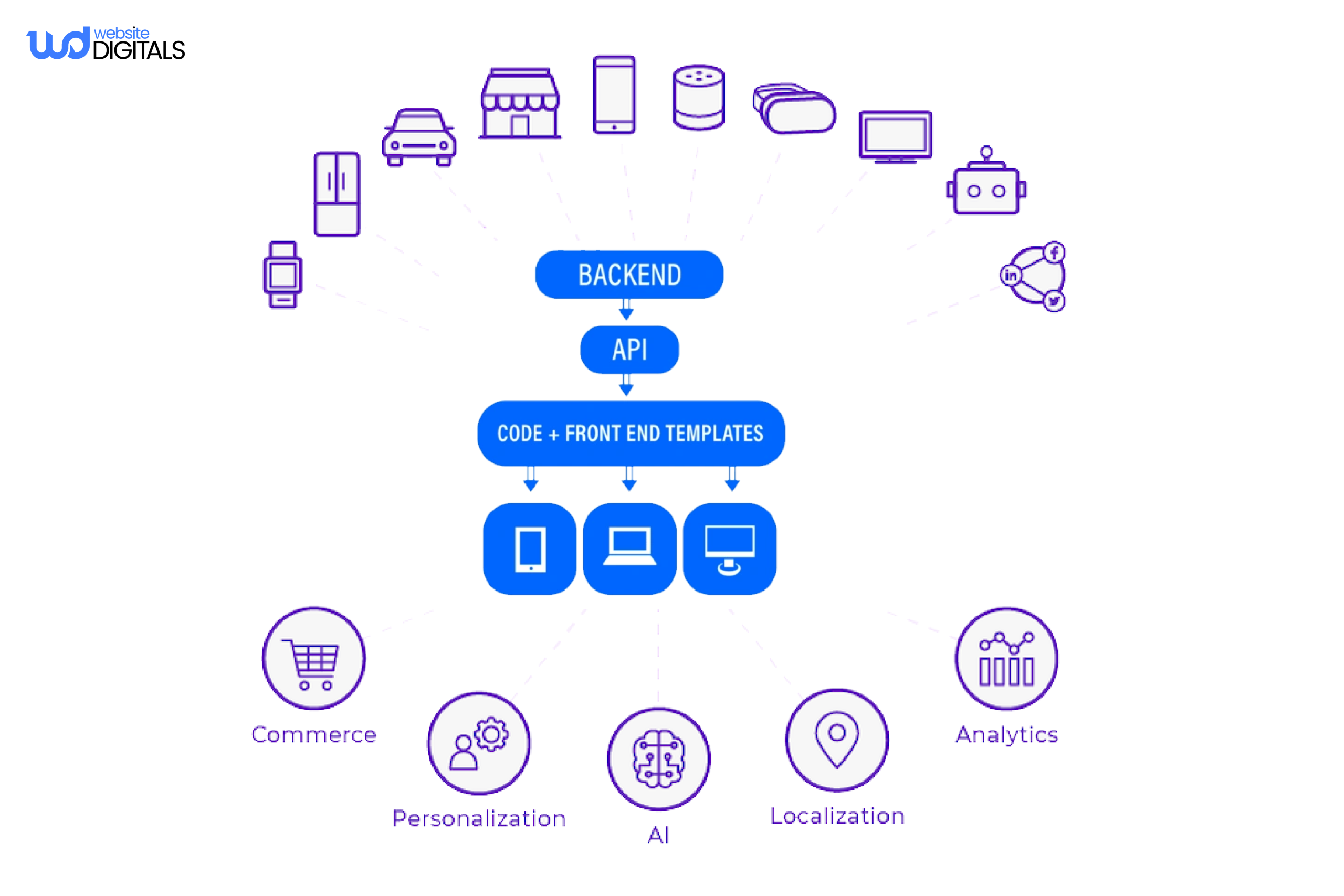
It is revolutionizing the headless ecommerce development company content strategies. It separates the frontend from the backend, providing a flexible and scalable content management solution.
This approach allows for content distribution across various channels.
Enhanced Content Flexibility and Reusability
The benefits include:
- Create Once, Publish Everywhere: Content can be published across different channels without needing to recreate or reformat it.
- Structured Content Models: It uses structured content models for easier management and reuse of content components across platforms.
Improved Performance and Site Speed
It includes CDN integration and reduces server load.
- CDN Integration: It ensures content delivery is fast to users worldwide by integrating with Content Delivery Networks (CDNs).
- Reduced Server Load: Decoupling the frontend from the backend significantly reduces server load.
Key Point: This leads to faster page loads and a better user experience.
Future-Proofing Your Ecommerce Platform
Headless CMS development company offers a future-proof solution for ecommerce businesses. It allows adaptation to new channels and technologies without being tied to a specific technology stack.
- Adapting to New Channels: It enables quick adaptation and content publishing on new platforms without significant redevelopment.
- Technology Stack Independence: With a headless CMS, you’re not bound to a specific technology stack.
Implementing Headless CMS for Ecommerce: Step-by-Step Guide
A structured approach ensures a seamless transition and maximizes the benefits of headless CMS features.
This is essential for your online store’s success.
Step 1: Assessing Your Current Content Architecture
- Start by examining your current content setup.
- Understand the content types, their usage, and any inefficiencies.
- This step is critical for identifying areas for improvement.
Content Audit Techniques
- Perform a detailed content audit to list and evaluate your content assets.
- Determine their relevance to your ecommerce strategy.
- This helps in making informed decisions about content management.
Identifying Integration Points
- Identify the key systems your headless CMS will integrate with.
- This includes ecommerce platforms, marketing tools, and other relevant systems.
- Seamless integration is vital for a smooth operation.
Step 2: Defining Your Multi-Channel Requirements
- Determine the channels for delivering content and their specific needs.
- This step is essential for creating a content strategy that meets diverse audience needs.
Channel Prioritization Strategy
- Develop a strategy to prioritize channels based on customer engagement and business goals.
- Consider technical feasibility as well.
- This ensures focus on the most impactful channels.
Content Modeling for Multiple Touchpoints
- Create a content model that works across various touchpoints.
- This ensures consistency and relevance, regardless of the platform.
Step 3: Selecting the Right Headless CMS Solution
- Choose a headless CMS that aligns with your ecommerce goals and budget.
- It should meet your technical requirements.
- This is a critical decision for your business’s success.
Evaluation Criteria Checklist
Use a detailed checklist to evaluate headless CMS solutions. Consider scalability, security, and ease of use. This helps in making an informed choice.
Proof of Concept Development
- Develop a proof of concept to test the selected headless CMS.
- Ensure it meets your specific needs and integrates well with your infrastructure.
- This step confirms the CMS’s suitability.
Step 4: Planning the Implementation Timeline
- Create a detailed project timeline with milestones and deadlines.
- Proper resource allocation is key to a successful implementation.
Phased Rollout Approach
- Implement a phased rollout to minimize disruption.
- This allows for adjustments as needed, ensuring a smooth transition.
Team Training Requirements
- Evaluate your team’s training needs.
- Ensure they are equipped to manage and utilize the new headless CMS effectively.
- Proper training is essential for successful implementation.
Top Headless CMS Platforms for Ecommerce in 2025
The right headless CMS boosts content flexibility, site performance, and customer experience.
We’ll look at top headless CMS platforms for ecommerce this year, covering enterprise-level, mid-market, and budget-friendly options.
Enterprise-Level Solutions
- Large-scale ecommerce operations need advanced features, scalability, and robust integration.
- Contentful and Adobe Experience Manager are prominent players in this space.
Contentful: Features and Ecommerce Capabilities
- Contentful is known for its API-first approach, enabling seamless content integration across channels.
- It offers product catalog management, content personalization, and omnichannel delivery for ecommerce.
Adobe Experience Manager: Integration Benefits
- Adobe Experience Manager (AEM) manages customer experiences across touchpoints.
- It integrates with Adobe Commerce (formerly Magento Commerce), providing a powerful ecommerce platform with advanced content management.
Mid-Market Options
- Mid-market headless CMS options balance features and cost.
- Strapi and Sanity are notable solutions in this category.
Strapi: Open-Source Flexibility
Strapi is an open-source headless CMS that offers flexibility and customization.
It allows developers to build custom applications and integrate with various ecommerce platforms.
Sanity: Content Studio Advantages
Sanity’s Content Studio is a real-time collaborative environment for content creation and management.
Its scalability and flexibility are ideal for growing ecommerce businesses.
Budget-Friendly Alternatives for Small Businesses
Small ecommerce businesses or startups often have limited budgets.
Fortunately, there are budget-friendly headless CMS alternatives like Ghost and Butter CMS.
Ghost and Butter CMS Comparison
Ghost is a simple, blog-focused CMS, while Butter CMS is a headless CMS that integrates with existing applications.
Both offer affordable plans, suitable for small businesses with basic content needs.
DIY Headless Solutions
For businesses with development resources, a DIY headless CMS solution can be cost-effective. Building a custom CMS is time-consuming but offers maximum flexibility.
Integrating Headless CMS with Popular Ecommerce Platforms
Headless CMS integration is transforming ecommerce by bringing unmatched flexibility. When you’re looking to adopt a headless CMS, it’s essential to know how to merge it with your ecommerce platform.
Headless CMS with Shopify
Shopify’s Storefront API makes integrating a headless CMS effortless. You can see this in many headless Shopify examples, where brands manage content across multiple platforms through a unified API-first setup.
Storefront API Implementation
Setting up the Storefront API requires configuring your headless CMS to pull data from Shopify. This setup ensures a unified content management experience.
Content Synchronization Strategies
To maintain content consistency, you can use synchronization strategies. These strategies update content across all platforms in real-time.
Headless CMS with Magento/Adobe Commerce
Magento’s GraphQL API offers a strong integration route for a headless CMS, and it boosts content delivery and management capabilities.
GraphQL Integration Approach
It allows you to fetch specific data from Magento, and this approach streamlines content retrieval and minimizes overhead.
Performance Optimization Techniques
To enhance performance, focus on caching, content delivery networks (CDNs), and efficient data querying. These strategies improve site speed.
|
Ecommerce Platform |
Integration Method |
Key Benefits |
|
Shopify |
Storefront API |
Unified content management, real-time updates |
|
Magento/Adobe Commerce |
GraphQL API |
Efficient data querying, enhanced performance |
|
WooCommerce |
REST API |
Flexible content management, WordPress decoupling |
|
BigCommerce |
Stencil Theme Customization |
Customizable storefronts, streamlined checkout flows |
Headless CMS with WooCommerce
WooCommerce integration with a headless CMS is made possible through the REST API. This integration offers flexible content management.
REST API Configuration
Configuring the REST API requires setting up endpoints for content retrieval and management. This ensures seamless integration.
WordPress Decoupling Strategies
Decoupling WordPress from WooCommerce allows for independent management of content and commerce.
Headless CMS with BigCommerce
BigCommerce integration involves customizing Stencil themes to work with a headless CMS. This customization enhances storefront flexibility.
Stencil Theme Customization
Customizing Stencil themes allows for tailored storefront experiences. These experiences align with your brand’s identity.
Checkout Flow Integration
Integrating checkout flows with a headless CMS ensures a streamlined shopping experience. This integration reduces cart abandonment rates.
Optimizing Multi-Channel Content Delivery with Headless Architecture
Consumers interact with brands on various touchpoints, demanding a seamless and consistent experience.
Headless CMS architecture helps achieve this by separating content creation from presentation, enabling flexible content distribution.
Creating Consistent Experiences Across Web, Mobile, and Apps
Businesses must implement a robust design system and define content transformation rules to ensure consistent experiences.
This ensures content is presented uniformly across different channels.
Design System Implementation
A well-designed design system is vital for maintaining consistency across all digital touchpoints.
It includes reusable components, guidelines, and standards for a uniform brand experience.
Content Transformation Rules
Defining content transformation rules is key to adapting content to different channels and devices.
These rules determine how content is formatted, resized, and displayed on various platforms, ensuring an optimal user experience.
Leveraging Headless CMS for Social Commerce
Headless CMS significantly enhances social commerce by integrating content seamlessly across various social media platforms.
Instagram Shopping Integration
Businesses can easily integrate their product catalogs with Instagram Shopping using a headless CMS.
TikTok and Pinterest Commerce
Headless CMS also facilitates integration of ecommerce content with TikTok and Pinterest.
This allows businesses to reach a broader audience and drive sales through these platforms.
|
Social Media Platform |
Commerce Integration Features |
Benefits for Businesses |
|
|
Shopping tags, product catalog integration |
Increased sales, enhanced customer experience |
|
TikTok |
Shopping links, product showcases |
Broadened audience reach, improved brand visibility |
|
|
Shopping ads, product pins |
Increased website traffic, boosted sales |
Preparing Content for Voice Commerce and IoT Devices
As voice commerce and IoT devices gain popularity, businesses must optimize their content for these emerging channels.
Structured Data for Voice Search
- Implementing structured data is essential for optimizing content for voice search.
- Schema markup provides search engines with a clear understanding of the content, making it more discoverable through voice queries.
Smart Display Content Optimization
- For IoT devices with smart displays, businesses should focus on optimizing content for visual presentation.
- High-quality images, concise descriptions, and intuitive navigation enhance the user experience.
Case Studies: Successful Headless CMS Implementations in Ecommerce
The shift to headless CMS has transformed ecommerce content management for top brands. This approach decouples content from the frontend, leading to greater flexibility, improved performance, and enhanced customer experiences.
Nike’s Conversion Rate Increase
Nike saw a significant boost in conversion rates by adopting headless CMS. This move improved site performance and user experience, making it more seamless.
Performance Improvements
Nike’s page load speed increased by 30%, contributing to higher conversion rates. The headless CMS optimized content delivery, making this possible.
Global Content Management
The headless CMS enabled Nike to manage content across regions and channels efficiently. This ensured a consistent brand experience globally.
Staples’ Approach to Enterprise Content Management
Staples, a leading office supplies retailer, transformed their enterprise content management with a headless CMS.
This change enabled them to revamp their B2B portal and implement a robust personalization strategy.
B2B Portal Transformation
Staples’ new B2B portal, built on headless CMS, offered a more intuitive and personalized experience for business customers. This led to increased engagement and sales.
Personalization Strategy
Staples leveraged the headless CMS’s content flexibility for a data-driven personalization strategy. This strategy improved customer satisfaction and loyalty.
Is Headless CMS the Right Choice for Your Ecommerce Business?
As you ponder upgrading your ecommerce strategy, the question lingers: Is headless CMS the ideal choice for your business?
You’ve likely seen the advantages of headless CMS for ecommerce. These include better content flexibility and enhanced site performance.
If you aim to future-proof your ecommerce platform, ensure consistent experiences across various channels, and enhance content management, headless CMS is a viable option.
The decision to adopt a headless CMS hinges on your business’s specific needs and ecommerce strategy. In this regard, stay connected with Website Digitals by calling us at (646)-222-3598, or you can email us at info@websitedigitals.com.
FAQs
What is a headless CMS, and how does it differ from a traditional CMS?
A headless CMS separates content creation and storage from the presentation layer. This setup offers more flexibility in content delivery across different platforms. In contrast, traditional CMSs tightly integrate content and presentation, limiting flexibility.
What are the benefits of using a headless CMS for ecommerce?
Using a headless CMS for ecommerce enhances content flexibility and reusability. It also improves site performance and future-proofs your platform. This approach allows for content to be published across various channels, adapting to new technologies without being tied to a specific platform.
How do I choose the right headless CMS solution for my ecommerce business?
To select the right headless CMS, evaluate your current content architecture and multi-channel needs. Assess the features and capabilities of different platforms. Consider scalability, security, and integration with your existing ecommerce setup.
Can I integrate a headless CMS with my existing ecommerce platform?
Yes, integrating a headless CMS with your existing ecommerce platform is possible. Platforms like Shopify, Magento/Adobe Commerce, WooCommerce, and BigCommerce offer APIs for seamless integration with headless CMS solutions.
How does headless CMS improve content delivery across multiple channels?
Headless CMS enables content to be created once and published everywhere. This ensures consistent experiences across web, mobile, and apps. It also prepares content for emerging channels like voice commerce and IoT devices.