Headless Shopify Examples That Prove the Power of Decoupled E-Commerce Solutions
“The best way to predict the future is to invent it.” – Alan Kay. This quote is deeply relevant in the e-commerce world, where innovation is essential for success.
As you explore the whole realm of online retail, you’re probably looking for ways to boost your store’s flexibility and performance.
If we look at it, decoupled e-commerce solutions, like headless commerce, are revolutionizing the field.
They separate the frontend and backend, allowing businesses to be more agile and customizable.
This method enables you to create a unique shopping experience. It leverages your e-commerce platform’s strengths while adapting to evolving consumer needs. So, delve into the blog to unveil headless Shopify examples today!
Key Takeaways
- Understand the concept of headless commerce and its benefits.
- Discover real-world examples of businesses thriving with decoupled e-commerce.
- Learn how headless solutions can enhance your store’s performance and flexibility.
- Explore the vast possibilities for customization and innovation in e-commerce.
- Gain insights into the future of online retail through headless commerce case studies.
What Makes an E-Commerce Solution “Headless”?
It separates the frontend from the backend. In a headless ecommerce Shopify setup, the frontend, handling user experience, is distinct from the backend commerce engine.
This engine manages business logic, inventory, and checkout processes.
|
“The decoupling of the frontend and backend allows businesses to innovate and iterate on their customer-facing applications without being constrained by the limitations of their commerce platform.” |
This separation strengthens businesses to adopt a best-of-breed approach.
They can pick the best frontend technology while using a powerful commerce engine for backend tasks.
The Technical Foundation of Decoupled Architecture
- The core of a headless commerce platform is its use of APIs (Application Programming Interfaces).
- These APIs enable developers to create custom frontend experiences.
- They can interact with the commerce engine in real-time, facilitating personalized product recommendations and streamlined checkout processes.
Note: By using a decoupled architecture, businesses can achieve faster page loads, improved SEO, and enhanced customer engagement. This leads to increased conversions and revenue growth.
The Business Case for Headless Shopify Implementation
Adopting a headless commerce architecture can revolutionize your online store’s performance and flexibility.
This approach decouples the frontend and backend, leading to a more streamlined and efficient e-commerce experience.
Enhanced Performance Metrics That Drive Conversion
- Headless Shopify integration significantly boosts performance metrics.
- Expect faster page loads, improved site responsiveness, and a more seamless user experience.
- These improvements drive conversion rates and boost revenue.
Example: A study of Akamai even 100-Millisecond Delays Can Impact Customer Engagement and Online Revenue.
Flexibility in Frontend Design and User Experience
- It offers the flexibility to create a unique frontend experience.
- By using modern frontend frameworks and technologies, you can design a customized user interface that reflects your brand identity.
- This flexibility allows for quick changes and updates, keeping your online store competitive and fresh.
Omnichannel Capabilities and Content Delivery
- It enables a consistent brand experience across various channels.
- With headless Shopify development services , the implementation, managing, and synchronization of content across web, mobile, and social media becomes effortless.
- This ensures a seamless and engaging experience for customers, regardless of their interaction with your brand.
Compelling Headless Shopify Examples Across Different Industries
Brands across various sectors, from fashion to furniture, are embracing headless Shopify to grow and expand their e-commerce offerings.
This strategy empowers businesses to remain competitive by delivering flexible, scalable, and high-performance online stores.
Let’s dive into how leading industry players have successfully integrated headless Shopify solutions into their operations.
Victoria Beckham: Fashion Forward with Headless Architecture
Victoria Beckham’s e-commerce platform stands out as a shining example in the fashion world.
By embracing headless Shopify examples like this, the brand has crafted a seamless online shopping journey.
Swift page loads and a stunning visual appeal mark this journey.
Result: The headless architecture also allows for instant updates across various platforms, ensuring a unified and engaging customer experience.
Koala: Reimagining Furniture Shopping Experience
Koala, a prominent Australian furniture retailer, has revolutionized its online presence with headless Shopify.
The brand’s focus is on creating an immersive shopping experience.
It enables customers to see products in their homes through augmented reality.
Outcome: This groundbreaking approach, bolstered by headless commerce, has led to elevated customer satisfaction and boosted conversion rates.
Allbirds: Sustainable Footwear with Sustainable Technology
Allbirds, celebrated for its eco-conscious footwear, has chosen headless Shopify to mirror its sustainable brand ethos.
The headless setup ensures a fast, secure, and scalable online store. This is essential for delivering a seamless customer experience.
What They Got? Allbirds has streamlined its operations and enhanced its online footprint.
How Direct-to-Consumer Brands Leverage Headless Architecture
Direct-to-consumer brands are adopting headless architecture to transform their e-commerce landscapes.
This approach decouples the frontend from the backend, fostering more adaptable, scalable, and customer-focused online stores.
MVMT Watches: Speeding Up the Customer Journey
MVMT Watches, a leading direct-to-consumer fashion brand, adopted headless architecture to enhance its customer journey.
Leveraging headless ecommerce solutions, MVMT Watches improved its website’s performance.
After Effects: This resulted in faster page loads and a smoother shopping experience, boosting customer satisfaction and driving sales.
Gymshark: Scaling Globally with Headless Solutions
With a headless ecommerce development company , it scaled its online presence across various regions, ensuring a consistent brand experience worldwide.
The flexibility of headless architecture allowed Gymshark to swiftly adapt to new markets and consumer demands.
Reminder for Success: Both MVMT Watches and Gymshark showcase the headless architecture benefits for direct-to-consumer brands.
Enterprise-Level Headless Commerce Success Stories
Headless commerce is transforming the online landscape for large corporations, bringing unmatched flexibility and scalability.
We’ll explore two success stories that showcase this transformation.
Staples: Transforming B2B Commerce with Headless Solutions
Staples, a prominent office supplies retailer, has revamped its ecommerce platform for B2B clients using headless solutions.
Notable Outcomes:
- By separating the frontend from the backend, Staples enhanced its customer experience. This change boosted customer satisfaction and operational efficiency.
- The adoption of a headless commerce platform allowed Staples to integrate with various third-party services.
- Staples’ online B2B commerce capabilities significantly improved, setting a new benchmark in the industry.
Heinz: Creating Custom Shopping Experiences
Heinz, a global food brand, adopted and developed a customized frontend that mirrors its brand identity.
Notable Outcomes:
- This customization enabled Heinz to offer a distinctive and engaging online shopping experience.
- Also, led to innovate and introducing new features.
- This kept its online presence dynamic and engaging.
- As a result, Heinz strengthened its online brand presence and fostered customer loyalty.
Technical Implementation: Headless Shopify Integration Strategies
Integrating headless Shopify involves considering various technical components. These components work together to create a seamless and efficient online store.
Popular Frontend Frameworks for Headless Shopify
Choosing the right frontend framework is critical when implementing headless Shopify, and popular options include React, Vue.js, and Angular.
Example: React’s component-based architecture is ideal for building reusable UI components, while Vue.js is known for its simplicity and flexibility, making it easy to integrate with existing projects. Angular, with its strong emphasis on structure and organization, is suitable for complex e-commerce applications.
API-First Approach: Leveraging Shopify’s Storefront API
Shopify’s Storefront API is a powerful tool for headless commerce, and the API-first approach ensures a flexible and scalable architecture.
This involves using the Storefront API to retrieve product information, manage carts, and handle checkout processes.
Effectively leveraging the Storefront API requires a deep understanding of GraphQL.
GraphQL allows for more efficient data querying compared to traditional REST APIs, resulting in faster page loads and improved overall performance.
Headless CMS Options That Pair Well with Shopify
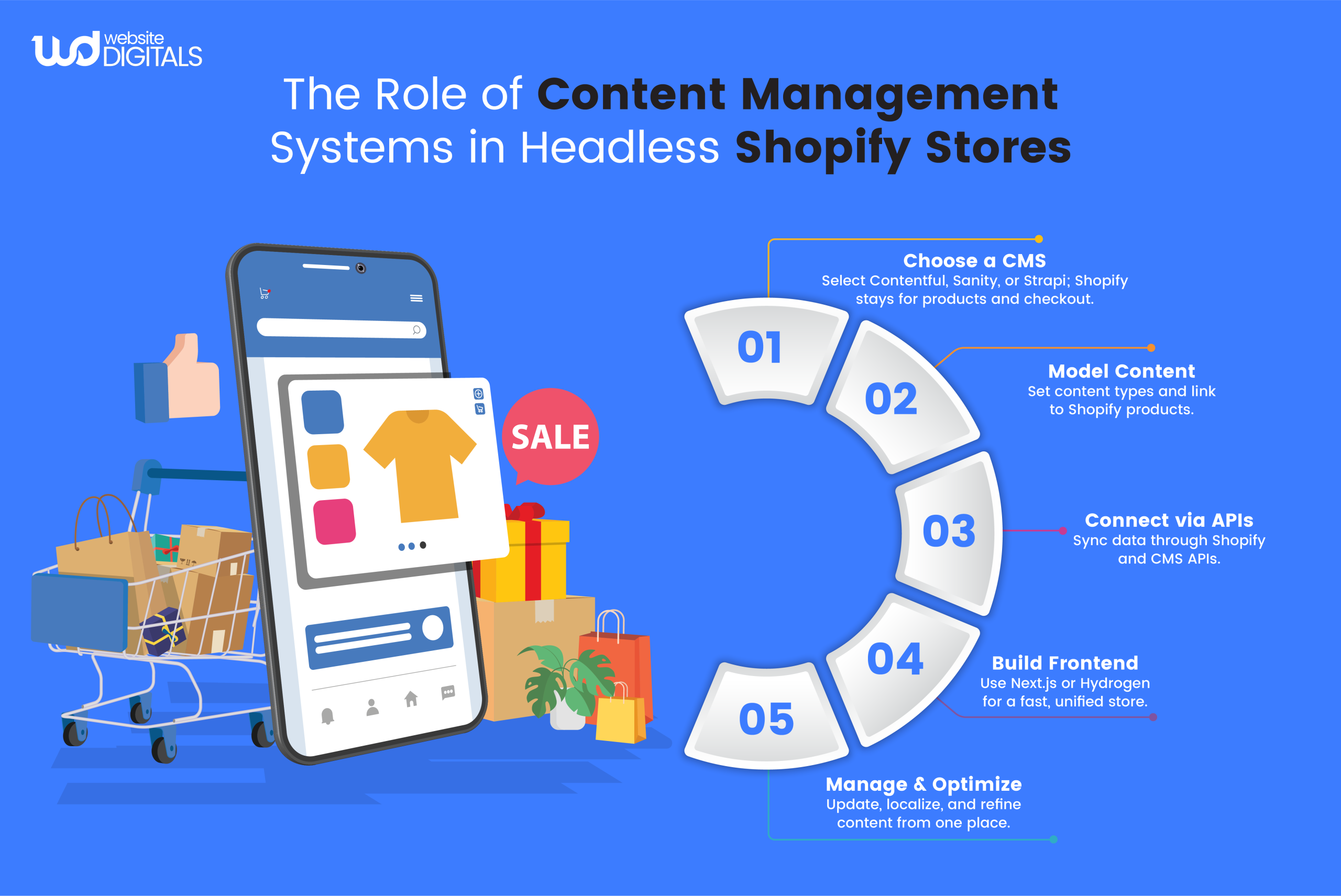
Integrating a headless CMS with Shopify can further enhance your e-commerce capabilities. Popular headless CMS options include Contentful, Strapi, and Contentstack.
These platforms provide a flexible way to manage content across different channels, ensuring consistency and ease of use.
Example: Contentful allows you to create and manage content in a structured manner. It makes it easy to integrate with your headless Shopify store. Strapi offers an open-source solution with extensive customization options.
Getting Started with Your Own Headless Shopify Implementation
Before starting with headless Shopify, evaluate if it fits your business objectives.
This architecture brings flexibility and performance boosts. Yet, it’s not for every business.
Assessing if Headless is Right for Your Business
Reflect on your business needs and technical readiness. Ask yourself:
- Do you need a highly customized frontend?
- Are you looking to improve page load speeds?
- Do you require omnichannel capabilities?
Soft Reminder: If you answered “yes” to these, headless Shopify could be ideal.
Building Your Technical Team and Stack
A skilled technical team is essential for headless Shopify success. You’ll need:
- Developers with frontend framework expertise, like React or Vue.js
- API integration specialists, focusing on Shopify’s Storefront API
- A team for managing and maintaining your headless CMS
Migration Strategies from Traditional to Headless
For a smooth migration to headless Shopify, adopt a phased approach:
- Begin with non-critical components
- Thoroughly test for compatibility
- Gradually introduce the new headless architecture
Key Note: Careful planning and execution are essential for a successful migration.
Measuring Success: Performance Metrics from Real Headless Shopify Examples
Understanding the impact of headless architecture requires examining key metrics. When you adopt headless Shopify, tracking specific performance indicators is essential.
It helps measure the success of your e-commerce platform.
Page Load Speed Improvements
- Headless Shopify significantly boosts page load speed.
- By separating the frontend from the backend, you can enhance your site’s performance.
- This leads to a superior user experience.
One fact indicates that a one-second delay in page load time can decrease conversions by 7%.
Conversion Rate Enhancements
- It offers a more personalized and streamlined user experience.
- This can lead to higher conversion rates.
- A seamless checkout process and intuitive navigation reduce friction.
- This makes it more likely for customers to complete their purchases.
Developer Experience and Iteration Speed
- The headless architecture also enhances developer experience. It allows for greater flexibility and faster iteration.
- With the frontend decoupled from the backend, developers can work more efficiently.
- This agility enables businesses to quickly adapt to market changes and customer needs.
Overcoming Common Challenges in Headless Commerce
Adopting headless ecommerce comes with its share of hurdles, from content management to SEO. It’s vital to grasp these challenges for a smooth transition to headless commerce solutions.
Managing Content Across Decoupled Systems
A robust content management system (CMS) is necessary for handling the demands of a headless architecture.
It must efficiently distribute content across various channels, ensuring consistency and freshness.
Key Strategies:
- Implement a headless CMS that integrates well with your Shopify store.
- Use APIs to streamline content distribution.
SEO Considerations for Headless Architecture
In a headless setup, optimizing your site for search engines requires meticulous planning.
This includes managing meta tags, structured data, and ensuring your site’s architecture supports proper crawling and indexing.
Best Practices:
- Use server-side rendering (SSR) to improve page load times and SEO.
- Ensure proper meta tag management through your headless CMS.
Balancing Web Development Costs with ROI
One major challenge in adopting headless commerce is balancing web development costs with ROI.
It’s critical to assess the costs of implementing a headless solution against the benefits, such as increased conversion rates and improved customer satisfaction.
|
Cost Factor |
Initial Investment |
Long-term ROI |
|
Development Costs |
High |
Positive |
|
Maintenance Costs |
Moderate |
Positive |
|
Performance Improvements |
Low |
High |
Embracing the Future of E-Commerce with Headless Shopify
The future of e-commerce is closely linked to headless commerce platforms. They enable brands to create tailored, omnichannel experiences.
This keeps brands competitive and meets the changing needs of their customers.
Adopting a headless Shopify example solution opens up new avenues for growth and innovation. It benefits both direct-to-consumer brands and large enterprises.
As you plan your e-commerce strategy, consider the advantages of headless Shopify. Join the Website Digitals to get through it! Give us a call at (646)-222-3598 or email us at info@websitedigitals.com.
FAQs
What is headless commerce, and how does it differ from traditional e-commerce architectures?
Headless commerce is an e-commerce model where the frontend and backend are separate. This allows for more flexibility in design and user experience. Unlike traditional platforms, it lets businesses create unique shopping experiences across different channels.
What are the benefits of implementing a headless Shopify solution?
A headless Shopify solution brings several advantages. It enhances performance, offers design flexibility, and supports omnichannel sales. These benefits lead to better customer experiences, higher conversion rates, and business scalability.
How do businesses manage content across decoupled systems in headless commerce?
Businesses manage content across decoupled systems using headless CMS options that work well with Shopify. This setup allows for seamless content creation, management, and delivery across various channels.
What are some popular frontend frameworks used for headless Shopify integrations?
React, Vue.js, and Angular are top frontend frameworks for headless Shopify integrations. They help developers build fast, responsive, and scalable applications that work with Shopify's Storefront API.
How do headless Shopify implementations impact SEO?
Headless Shopify implementations can affect SEO if not managed correctly. To avoid this, businesses should focus on SEO strategies like optimizing meta tags, using server-side rendering, and ensuring the site is crawlable.
Can headless commerce solutions be integrated with existing e-commerce platforms?
Yes, headless commerce solutions can integrate with existing platforms like Shopify. This is done by using APIs, such as Shopify's Storefront API, to separate the frontend and backend. This separation offers more flexibility and customization.
What are some examples of businesses that have successfully implemented headless Shopify solutions?
Victoria Beckham, Koala, Allbirds, MVMT Watches, and Gymshark are examples of businesses that have successfully implemented headless Shopify solutions. They've used headless commerce to improve customer experiences, enhance performance, and scale their businesses.