How to Fix Slow Website Loading and Improve Performance
A slow website is a silent revenue leak.
If your traffic is steady but inquiries are dropping, performance is likely the culprit.
The data from Google research shows that as load times move from one to three seconds, bounce rates rise by 32%. By five seconds, that risk spikes to 90%.
Since “users spend most of their time on other websites” (Jakob Nielsen), they have zero patience for lag. They expect your site to work as well as the best ones they visit.
This guide shows you how to fix slow website loading and how to identify these bottlenecks and fix the UX issues that are currently costing you leads.
Key Takeaways
|
The Business Impact of Slow Website Performance
Website performance sets the tone for the entire user experience.
When pages load slowly, users subconsciously associate that delay with inefficiency and risk.
In the marketplace, where trust and credibility heavily influence buying decisions, even small delays can derail conversion momentum.
Slow websites increase bounce rates, reduce time on site, and weaken SEO rankings as engagement signals decline.
Paid campaigns become more expensive because users abandon before converting. Sales teams feel the impact downstream when lead quality drops or inquiry volume shrinks.
Speed is no longer just a technical metric.
It is a growth lever that directly affects increase website leads, and it’s often the first step in understanding how to improve a website for long-term revenue growth.
Common Causes of Slow Website Loading
Performance problems often originate from frontend assets that are too heavy, backend systems with poor server response time, or interfaces that fail under real-world conditions like mobile networks and varied devices.
Understanding these causes is essential before attempting to optimize anything.
-
The Hero Image Trap:
Hero sections are often designed to impress visually, but they are one of the most common contributors to slow-loading pages.
Large, uncompressed images delay large contentful paint (LCP) and inflate perceived load time, especially on mobile.
Without proper image optimization and lazy loading, hero images block meaningful content from appearing quickly.
When the first thing users see loads slowly, the entire site feels slow, even if the rest of the page is optimized.
-
Plugin Bloat and “Tool Overload”:
As websites grow, reliance on third-party tools increases.
Analytics platforms, chat widgets, CRM integrations, and marketing automation scripts all add value individually, but collectively they introduce performance drag.
This is especially common in WordPress performance issues, where excessive plugins lead to plugin conflicts, unnecessary database queries, and bloated JavaScript execution.
What starts as convenience eventually becomes a performance bottleneck that affects both frontend experience and backend stability.
-
The Hidden Cost of Inexpensive Hosting:
Low-cost hosting solutions are appealing early on, but they rarely scale with business growth.
Shared environments, limited server resources, and inconsistent uptime all contribute to poor Time to First Byte (TTFB).
When web hosting performance is weak, users experience delays before the content even begins to load.
No amount of caching or frontend tuning can fully compensate for an underpowered hosting stack.
Server geography also plays a role.
Using the correct server location (US data centers) combined with a CDN (Content Delivery Network) ensures faster delivery for distributed audiences.
-
Mobile vs. Desktop Disconnect:
Many websites perform reasonably well on desktop but struggle on mobile.
Heavy scripts, unoptimized layouts, and inefficient resource loading severely impact mobile page speed.
With mobile-first indexing, search engines evaluate mobile performance before desktop.
Poor responsive design performance leads to lower engagement, weaker rankings, and lost conversions, especially for high-intent mobile users.
-
The Technical “Messy Middle”:
Between design and infrastructure lies a layer of technical complexity that users never see but always feel. Render-blocking resources delay content display.
Poor critical CSS handling causes visual instability. JavaScript without JavaScript defer or JavaScript async blocks interaction.
When assets are not reduced through minification, or when compression methods like GZIP compression and Brotli compression are missing, payload sizes grow unnecessarily.
Modern delivery protocols such as HTTP/2 and HTTP/3 further improve speed but are often underutilized.
Together, these inefficiencies create lag, instability, and frustration.
Turning Performance into a Competitive Advantage
-
Speed as a Conversion Tool:
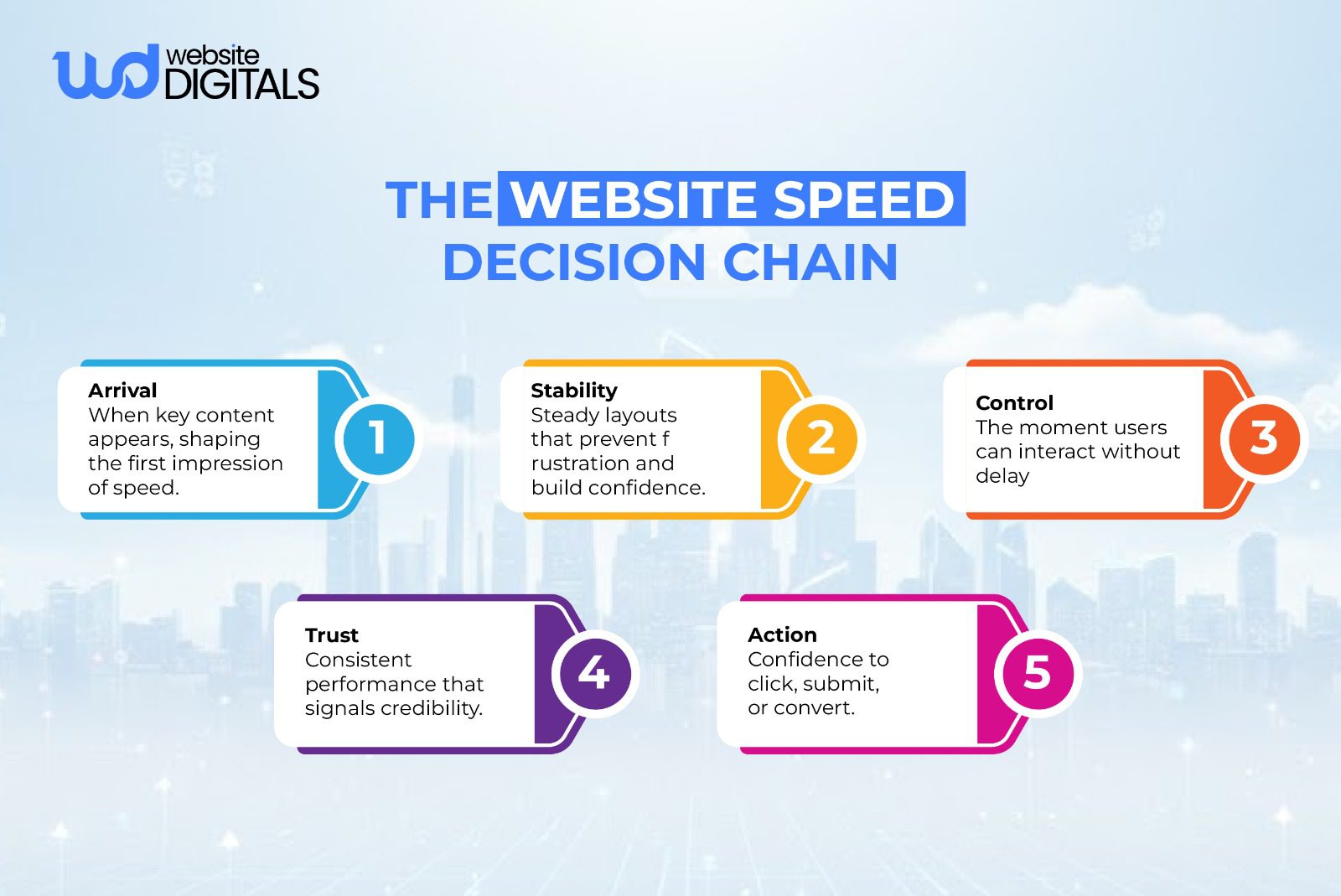
Speed directly affects how quickly users reach CTAs and how confidently they interact with them.
When pages load fast and respond instantly, users are more likely to complete forms and move deeper into the funnel.
Optimized performance supports web development efforts by ensuring that delays do not undermine design and messaging.
Real World Case Study:
|
Euronics, a consumer electronics retailer on Shopify Plus, conducted a targeted performance optimization project focusing on key metrics like Largest Contentful Paint (LCP), First Contentful Paint (FCP), and Total Blocking Time (TBT). After implementing technical improvements, such as reducing JavaScript execution time, cleaning up large DOM sizes, optimizing caching, and cutting network payloads, the site achieved dramatic speed gains: LCP improved from 5.8s to under 2.5s, FCP dropped below 1s, and TBT shrank to under 300ms. These changes significantly enhanced user experience and are expected to positively influence conversions and SEO performance due to faster and more responsive pages. |
-
Fixing the “Broken” User Experience:
Many UX problems are actually performance problems.
Layout shifts break trust, delayed scripts interrupt form completion, and unstable interactions frustrate users.
By improving Core Web Vitals, including Interaction to Next Paint (INP) and Cumulative Layout Shift (CLS), the experience becomes predictable and reliable, allowing UX design to function as intended
Pro Tip: Optimize for Perceived Speed
|
Even when total load time can’t be reduced immediately, improving visual feedback, interaction readiness, and layout stability dramatically improves user perception and conversion behavior. |
-
The Trust Factor:
Trust is built through consistency.
Fast, stable websites signal professionalism and attention to detail.
Slow or unstable sites raise doubts, even when content quality is high.
For brands focused on lead generation, performance is a silent credibility signal that influences whether users engage or abandon.
-
Revenue Optimization:
Performance improvements compound over time.
Faster pages reduce acquisition costs, strengthen SEO efficiency, and improve conversion rates across paid, organic, and referral channels.
When speed is aligned with CRO strategy, it becomes a core driver of revenue optimization rather than a maintenance task.
Speed Optimization Priority by Business Stage
|
Business Stage |
Speed Focus |
Risk if Ignored |
|
Launch |
Fast initial render and stable layouts |
Poor first impressions and early bounce |
|
Growth |
Mobile performance and interaction speed |
Lost high-intent traffic and leads |
|
Scale |
Infrastructure and backend efficiency |
Performance drops during traffic spikes |
|
Monetization |
Conversion flow and form responsiveness |
Lower conversion rates and revenue loss |
|
Maturity |
Performance monitoring and maintenance |
Gradual SEO decline and UX degradation |
A Professional Roadmap to Optimization
Fixing performance requires structure.
Random fixes create short-term gains but rarely solve systemic issues.
A professional roadmap ensures improvements are intentional, measurable, and aligned with business goals.
Phase 1: The Critical Content Audit
This phase focuses on prioritizing above-the-fold content and removing unnecessary payload.
Heavy assets are optimized, scripts deferred, and visual stability improved so users receive value quickly.
Phase 2: Streamlining the Technical Foundation
Infrastructure, caching, and database optimization are addressed in this phase.
Backend performance is stabilized, delivery is optimized, and scalability is ensured to support growth without degradation.
Phase 3: Repairing the Conversion Funnel
Performance improvements are aligned with CRO goals.
Forms, CTAs, and interactive elements are tested under real conditions to ensure they respond instantly and reliably.
This is where speed improvements directly increase website leads.

Wrapping It Up – Turning Website Speed Into Measurable Lead Growth
Website performance isn’t about perfect scores; it’s about removing friction and restoring trust in the user journey.
A fast website signals credibility, keeps visitors engaged, and supports confident decision-making.
When businesses understand how to fix slow website loading, speed becomes a growth asset rather than a limitation.
Faster load times reduce bounce rates, improve engagement, and turn website traffic into qualified leads, making performance a clear competitive advantage.
If you’re serious about performance that drives real lead growth, our website speed optimization services at Website Digitals are built to eliminate friction, stabilize UX, and convert traffic into qualified leads.
Connect with us at info@websitedigitals.com or reach out directly at (646)-222-3598 to start transforming your website speed into measurable business results.
FAQs
How does Website Digitals approach website speed optimization?
Website Digitals focuses on performance as a conversion system, aligning speed improvements with UX stability, SEO impact, and lead generation outcomes.
Can Website Digitals optimize speed without redesigning my website?
Yes. Most performance issues are structural and technical, not visual, allowing optimization without disrupting brand design.
Why is my website loading slow, even with good hosting?
Frontend issues like heavy images, scripts, and layout instability often outweigh hosting performance.
What causes slow website loading most often?
Unoptimized assets, plugin overload, poor caching, render-blocking resources, and weak mobile performance.
How can I diagnose slow website performance accurately?
By analyzing Core Web Vitals, server response time, mobile behavior, and real-user interaction delays.
How does page speed affect SEO rankings?
Slow pages weaken engagement signals, reduce crawl efficiency, and hurt rankings under mobile-first indexing.
What is a good website loading speed today?
A site should feel usable within one second and fully stable before users attempt interaction.