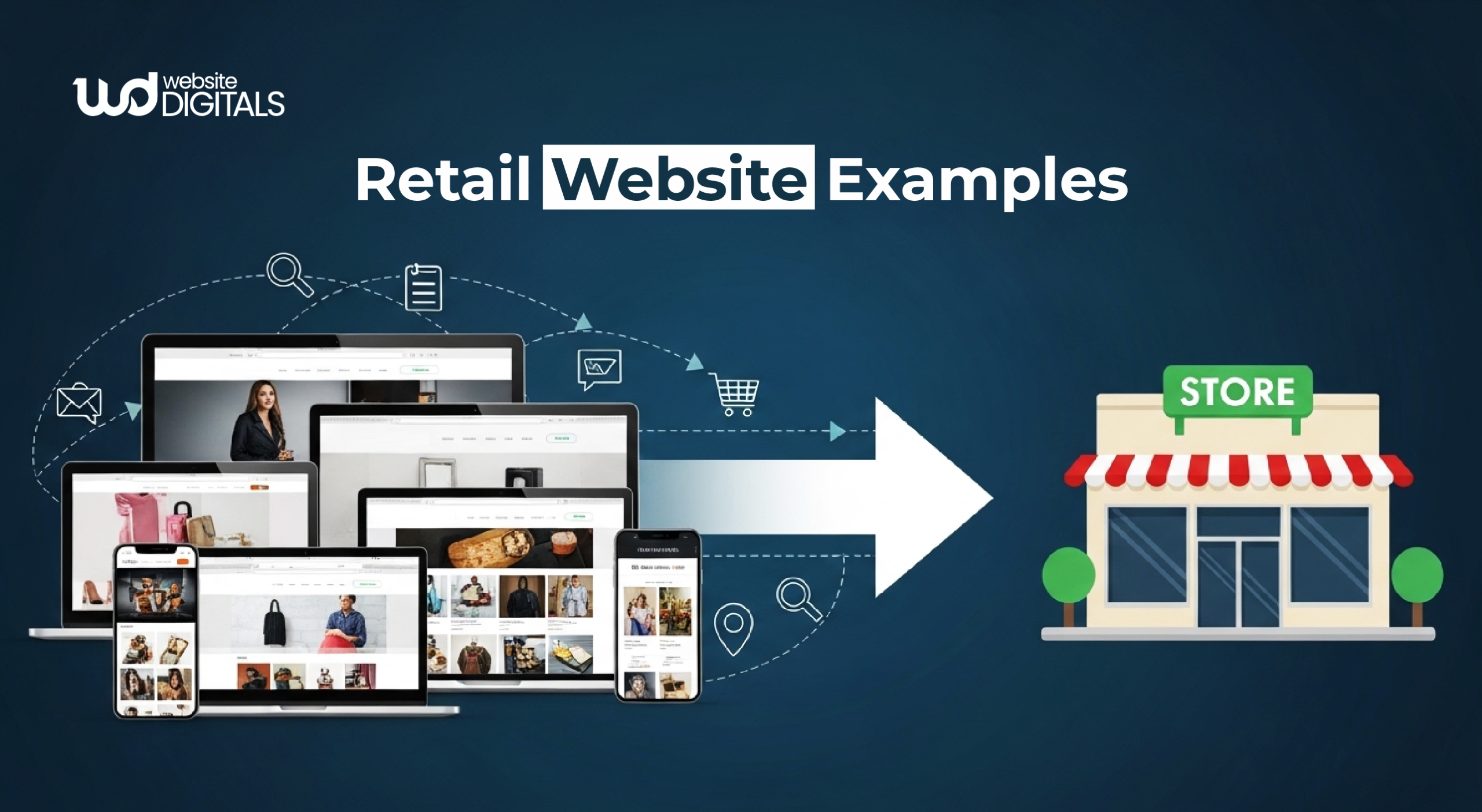
5 Retail Website Examples That Influence How Digital Research Leads to Store Visits
Many retailers focus on improving in-store experiences while overlooking the moment when the decision to visit is actually made.
According to research, nearly 83% of shoppers check a retailer’s website before deciding to visit a store.
If that experience feels unclear or unhelpful, the visit never happens.
Studying strong retail website examples makes one thing clear: digital research isn’t a side activity; it’s the filter customers use to decide where to go.
Websites that guide this phase well don’t just inform; they drive foot traffic.
In this blog, you’ll see five retail website examples that explain how online research turns into real store visits.
Key Takeaways
|
Why Retail Websites Matter Even When the Sale Happens In-Store
Many business owners assume that if most sales happen at a physical register, their website plays a secondary role. That assumption is costly.
In an omnichannel retail environment, customers expect consistency across every touchpoint.
If a website feels outdated, unclear, or incomplete, shoppers assume the in-store experience will be the same.
Before visiting, customers quickly evaluate three things:
- Do you have what they need?
- Is the price reasonable?
- Can the business be trusted?
If a website fails to answer these questions within seconds, shoppers don’t just leave; they choose a competitor that does.
Key Website Elements That Influence In-Store Buying Decisions
To turn a casual browser into an in-store shopper, your digital storefront must do more than just look pretty.
It needs to function as a resource.
-
First Impressions & Brand Credibility
When a user lands on your page, the visual hierarchy should immediately guide them to the most important information.
Within three seconds, they should know who you are and what you sell.
Retail branding is about more than a logo; it’s about the feeling a customer gets when they see your colors, typography, and imagery.
If there is a disconnect between the “vibe” of your website and the “vibe” of your store, it creates cognitive dissonance that leads to a loss of trust.
-
Product Discovery Before the Visit
A robust product catalog is essential. Customers use websites to shortlist items.
If they can’t find a specific item online, they will assume it isn’t in the store.
Effective product discovery tools, such as advanced product filters and a high-performing search functionality, allow users to narrow down their choices by size, color, price, and, most importantly, local availability.
-
Location, Inventory & Store Information
This is where many retailers fall short.
A simple “About Us” page is not enough.
You need an accurate store locator that provides real-time data. Modern shoppers expect to see “3 in stock at your local store.”
By providing this level of detail, you remove the “friction of uncertainty.”
How Retail Website Features Build Shopper Confidence Before Store Visits
|
Retail Website Feature |
How It Affects Shopper Confidence |
Likelihood of Store Visit |
|
Clear product images and detailed specs |
Removes guesswork and sets accurate expectations |
High |
|
Real-time local inventory visibility |
Confirms the trip will be worthwhile |
Very High |
|
Reviews, ratings, and return policies |
Reduces perceived risk and builds trust |
High |
|
Fast-loading, mobile-friendly pages |
Supports quick, on-the-go decision-making |
Medium to High |
|
Advanced search and product filters |
Shortens research time and reduces frustration |
High |

5 Best Retail Website Examples That Influence In-Store Buying Decisions
Examining successful retail website examples allows us to see these theories in practice.
Let’s look at five industry leaders who have mastered the art of driving foot traffic through digital excellence.
1. Target
Website Experience Overview
Target has mastered the art of making the digital experience feel identical to the physical one.
When you visit their site, the website layout is clean, organized, and uses the signature red branding that customers recognize instantly.
Key Features Influencing In-Store Behavior
- Real-time local store inventory visibility
- Clear pricing, deals, and in-store promotions
- Strong store locator with pickup and aisle context
- Consistent branding between digital and physical stores
Why It Works for Pre-Visit Decision-Making
It removes the “search” from the shopping trip.
A customer can build their list on the mobile commerce design of the app or site and walk directly to the shelf. This efficiency builds immense loyalty.
2. Home Depot
Website Experience Overview
For a home improvement retailer, the stakes are high. Customers are often buying heavy, expensive, or technical items.
Home Depot’s ecommerce website isn’t just a store; it’s an encyclopedia.
Key Features Influencing In-Store Behavior
- Detailed product specifications and comparisons
- In-store availability by exact location
- Educational content and buying guides
- Clear “pick up in store” pathways
Why It Works for Pre-Visit Decision-Making
Home Depot understands that its customers often need more than just a product; they need a solution.
By providing the education online, they prime the customer to purchase in person.
3. Best Buy
Website Experience Overview
Electronics are high-consideration purchases.
People want to touch the keyboard, see the screen resolution, and hear the speakers. Best Buy uses its site to facilitate this “show-rooming” behavior.
Key Features Influencing In-Store Behavior
- Side-by-side product comparison tools
- Customer reviews and expert ratings
- Clear store availability and demo expectations
- Appointment scheduling and in-store consultation cues
Why It Works for Pre-Visit Decision-Making
They use trust badges and expert recommendations to build authority.
By the time the customer reaches the store, they aren’t “just looking”; they are there to verify their online research and finalize the transaction.
4. Nike
Website Experience Overview
Nike doesn’t just sell shoes; they sell a lifestyle.
Their online shopping experience is immersive, using high-quality video and storytelling to create an emotional bond with the consumer.
Key Features Influencing In-Store Behavior
- Strong product visuals and lifestyle imagery
- Clear differentiation between online and in-store experiences
- Store locator integrated with product exploration
- Membership benefits explained before visiting
Why It Works for Pre-Visit Decision-Making
They focus on the ecommerce conversion funnel by moving people from “interest” to “brand devotee.”
The website sells the dream, and the store fulfills the physical product.
5. Warby Parker
Website Experience Overview
Warby Parker changed the game by realizing that the biggest barrier to buying glasses online was the fear of them not fitting.
Their website is designed specifically to solve that problem and drive people into their boutiques.
Key Features Influencing In-Store Behavior
- Clear pricing and no hidden fees
- Virtual try-on and style guidance
- Seamless store locator with appointment booking
- Transparent policies explained upfront
Why It Works for Pre-Visit Decision-Making
They have an incredibly smooth checkout flow, but they don’t force it.
They offer a “Home Try-On” or an “In-Store Visit,” giving the customer total control over the omnichannel experience.
The Common Pattern Across These Retail Website Examples
Despite selling different products, these retailers follow the same principles:
- They reduce uncertainty with clear pricing, stock, and location data
- They build trust digitally through transparency, security, and reviews
- They align expectations between the website and the store experience
- They prioritize mobile usability for on-the-go decisions
That’s why their websites influence buying decisions long before customers walk through the door.
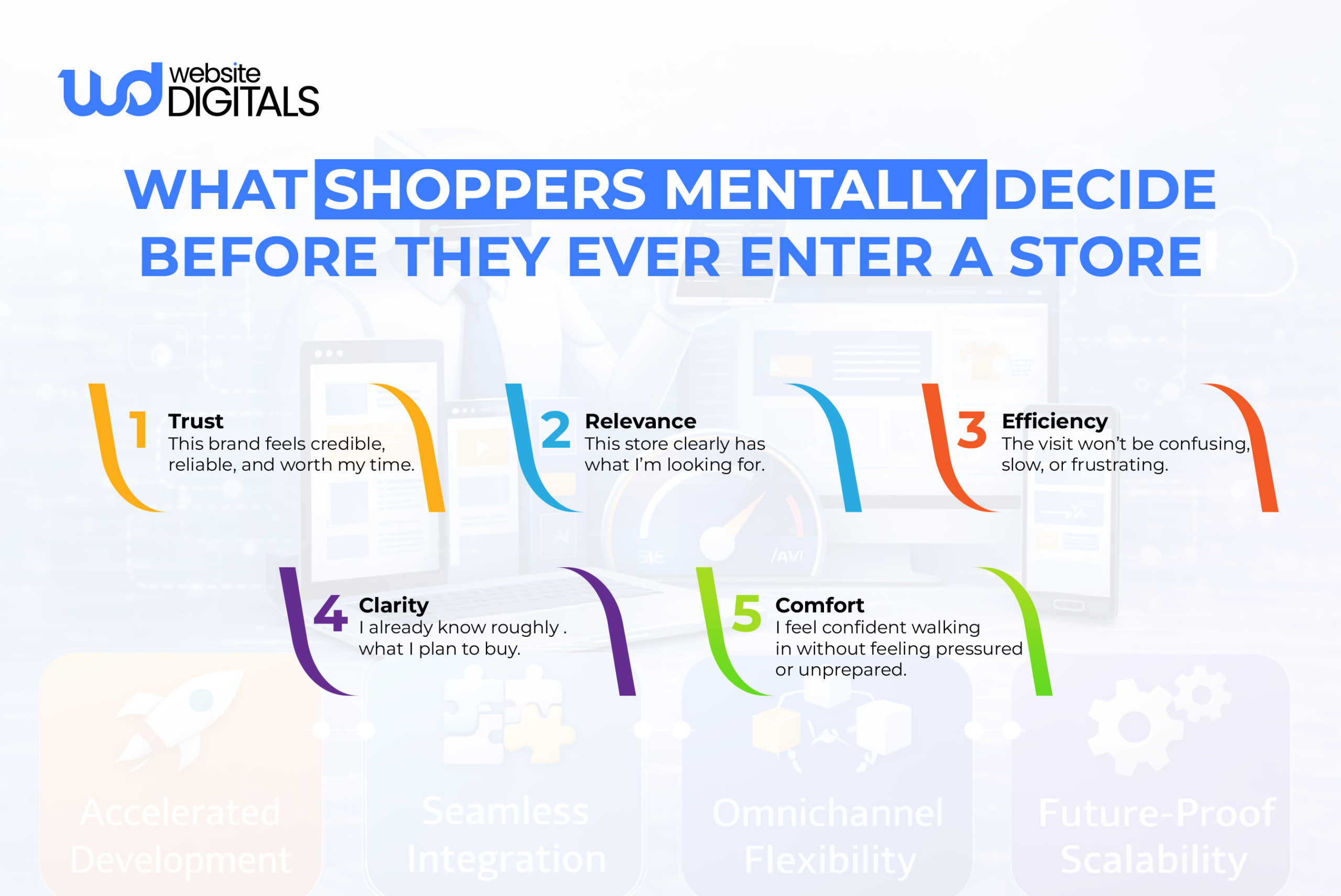
How Shoppers Use Retail Websites Before Visiting a Store
Example #1: Making Sure the Product Matches Expectations
Shoppers seek reassurance that online visuals reflect real products.
High-quality images, videos, and detailed descriptions allow them to evaluate items digitally, reducing hesitation before visiting.
Real-World Case Study
|
Wayfair reduces hesitation in furniture shopping by using machine learning and visual search to help customers find what they want faster and with more confidence. Features like “Search with Photo” and room-based visualization tools allow shoppers to match styles and preview products in real spaces before buying. By removing guesswork and personalizing discovery, Wayfair makes online research feel closer to an in-store experience and encourages more confident purchase decisions. |
Tip:
|
For products where scale or fit matters, show items in real-world settings, not just studio shots. |
Note:
|
If shoppers can’t visualize the product online, they delay the store visit or abandon it entirely. |
Example #2: Checking Local Availability Before Choosing a Store
Before leaving home, shoppers confirm whether a visit is worthwhile. Real-time inventory, localized promotions, and accurate store information guide store selection.
Tip:
|
Surface local stock availability directly on product and category pages, not only during checkout. |
Example #3: Learning What to Buy Before Talking to Staff
Educational content helps shoppers arrive informed. Buying guides and comparisons reduce confusion and make in-store conversations more efficient.
Real-World Case Study
|
REI turns online research into confident store visits by using detailed buying guides to educate shoppers before they ever walk in. For products like backpacks, tents, and footwear, its guides break down fit, use cases, and performance differences, helping shoppers narrow choices ahead of time. As a result, customers arrive at REI stores with clear requirements, informed questions, and higher purchase confidence, making the in-store experience faster, smoother, and more decisive. |
Tip:
|
Focus educational content on decision clarity (“Which option is right?”), not product promotion. |
Note:
|
Prepared shoppers shorten staff interaction time while increasing conversion likelihood. |
Example #4: Deciding Whether the Store Can Be Trusted
Trust is formed online through reviews, policies, security signals, and brand transparency.
A well-maintained website signals professionalism before any face-to-face interaction.
Tip:
|
Place reviews, return policies, and guarantees where shoppers make decisions, on product and category pages. |
Note:
|
Shoppers often judge business credibility online before committing time to a store visit. |
Example #5: Using Mobile to Make Last-Minute Store Decisions
Mobile users expect speed and clarity. Quick access to stock checks, directions, and contact details turns spontaneous intent into store visits.
Bonus Tip:
|
Design mobile pages around urgency: availability, hours, directions, and click-to-call should be instantly accessible. |
Why This Matters
Across these steps, retail websites function as decision filters, not just marketing tools.
When they reduce uncertainty, support research, and respect shoppers’ time, they directly influence whether a store visit happens at all.
Wrapping It Up
A modern retail website should act as a silent partner to the physical store, building trust, answering questions, and removing friction before a visit happens.
These retail website examples show that brands driving foot traffic succeed by prioritizing clarity and usability, ensuring the online experience matches what customers find in-store.
When in-store sales lag, the issue is rarely visual alone. It’s usually a disconnect between online research and offline shopping.
Fixing that gap requires UX decisions rooted in real customer behavior.
If you want to understand whether your website supports or hinders store visits, the experts at Website Digitals can help. Reach out at info@websitedigitals.com or connect with us on call (646)-222-3598 to start improving how your customers shop.
FAQs
1 How does Website Digitals help improve retail websites that support in-store sales?
Website Digitals focuses on aligning digital experiences with real customer behavior, ensuring retail websites reduce friction, build trust, and support in-store shopping decisions.
2 Can Website Digitals review an existing retail website for UX and performance gaps?
Yes. Website Digitals evaluates retail websites across usability, clarity, mobile experience, and conversion paths to identify issues that may be limiting foot traffic.
3 Where can businesses find retail website examples for inspiration?
Retail website examples for inspiration are best found by studying brands that clearly present products, show local availability, and guide shoppers before store visits—not just visually attractive sites.
4 What makes a good retail website today?
A good retail website prioritizes clear navigation, strong product discovery, accurate store information, mobile usability, and trust signals that help shoppers decide before visiting a store.
5 What are the most important modern retail website design trends?
Modern retail website design trends focus on mobile-first layouts, fast page speed, real-time inventory visibility, simplified navigation, and seamless online-to-offline experiences.