How to Minimize Web Portal Development Costs Without Compromising Quality
Web portal projects often reveal cost differences that aren’t obvious at the planning stage. Yes, you read that right!
What appears to be a straightforward build becomes more complex once detailed requirements and estimates are reviewed.
Web portal development costs are higher because portals aren’t digital brochures; they are interactive systems built to manage users, process data, and secure sensitive transactions.
As Warren Buffett puts it,
“Price is what you pay. Value is what you get.”
That value comes from custom architecture, user dashboards, and authentication systems that make a portal secure and scalable.
In this blog, we’ll break down what actually drives those costs and how to reduce them without sacrificing quality, so your portal becomes a long-term business asset, not a budget risk.
Key Takeaways
|
Why Web Portal Development Costs Are Higher Than Expected
When people ask how much does it cost to pay someone to build a website, they are usually thinking of a standard, content-driven site.
A web portal, however, is priced differently because it is designed to support ongoing user interaction rather than simple content display.
Unlike a website where every visitor sees the same pages, a web portal delivers personalized experiences through user logins, role-based access, and dynamic data processing.
Supporting these features requires robust backend development, secure databases, and tightly controlled workflows.
This added technical complexity, rather than visual design, is what drives a higher web portal development cost compared to a traditional website.
Website Cost vs. Web Portal Development Cost
-
Website Cost
A standard business website usually focuses on SEO, brand messaging, and simple lead forms, which keeps development fairly straightforward.
-
Web portal development:
On the other hand, it is about building a working system where users can log in, manage accounts, access private data, and complete real tasks.
That difference shows up clearly in pricing.
While a small business website often costs $5,000 to $15,000, a professional web portal typically starts around $25,000 and can go beyond $150,000 for enterprise-level needs.
The higher cost isn’t about visuals; it reflects the work required to build a secure, scalable platform that supports day-to-day business operations, not just an online presence.
Key Factors That Affect Web Portal Development Cost
Understanding web portal development cost requires recognizing that portals are far more complex than standard websites.
Unlike simple websites focused on content, web portals involve user interactions, data processing, and secure workflows, which drive up development costs.
1. Feature Complexity and Custom Development
The number of unique features in your web portal is the biggest factor driving its development cost. For instance, a simple document repository will cost far less than a SaaS multi-tenant architecture designed to handle thousands of concurrent users.
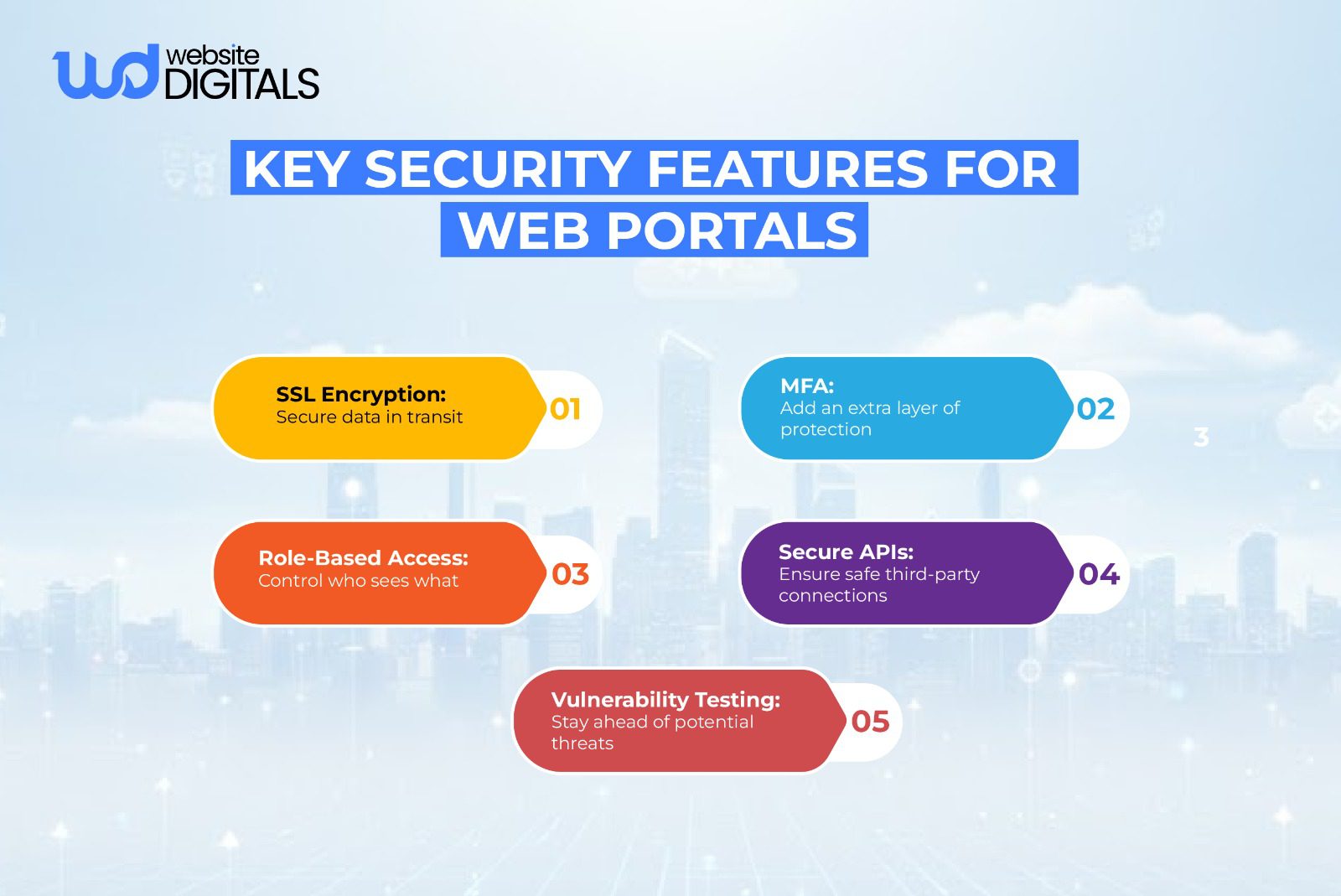
- User authentication is another key cost driver. While basic login functionality is standard, implementing Single Sign-On (SSO) or multi-factor authentication (MFA) requires additional backend development, which increases complexity and cost.
- User dashboard development also impacts cost. Creating personalized dashboards that pull real-time data demands extensive frontend development to ensure the interface remains both responsive and intuitive for users.
Real World Scenario:
|
A mid-sized retail company developed a $120,000 customer self-service portal with SSO, real-time order tracking, and personalized dashboards. This investment led to improved customer satisfaction and reduced the workload on customer service agents. |
2. Backend and Frontend Development Effort
Backend development handles data validation, business logic, and security.
More sensitive data or higher transaction volumes require a robust backend.
On the frontend, complex user dashboards need to present real-time data while ensuring responsiveness and ease of use, which increases development effort.
3. Database Design and System Integration
Effective database design and system integration are critical for portals.
Integrating with existing systems (e.g., ERP, CRM) requires data mapping and synchronization, impacting the overall cost.
Additionally, accessing and managing large amounts of data can be resource-intensive.
4. API and Third-Party Integrations
APIs enable portals to connect with third-party systems, but integrating them securely takes expertise.
Custom coding these integrations adds to the development cost, as it requires ensuring they work reliably and securely.
5. Security, Compliance, and Data Protection
Security and compliance add considerable cost, especially for industries like healthcare or finance that require strict regulations (e.g., HIPAA).
Secure portal architecture, including encrypted storage and regular audits, increases upfront costs but is necessary to prevent data breaches and legal issues.
How Much Does a Custom Web Portal Cost in the US?
In the United States, the average web portal development cost is influenced by high labor rates and a focus on high-quality website development services.
Here is a general breakdown of what to expect in 2026:
|
Portal Type |
Estimated Cost Range (USD) |
Timeline |
|
Simple / MVP Portal |
$25,000 – $50,000 |
2–4 Months |
|
Mid-Range Business Portal |
$50,000 – $120,000 |
4–8 Months |
|
Enterprise / Complex Portal |
$150,000 – $500,000+ |
8–12+ Months |
These figures represent the enterprise application pricing typical for US-based agencies that provide end-to-end support, from strategy to deployment.
If you are looking for website developers for small business, you might find lower entry points, but be cautious of the “feature creep” that can quickly bloat a small budget.
Strategic Ways to Reduce Web Portal Development Cost
By making smart architectural and managerial choices early on, you can keep the digital transformation costs under control.
-
How Clear Requirements Help
Vague requirements lead to “guesswork development,” where teams build features that don’t actually solve the business problem.
A detailed discovery phase helps in creating a realistic cost estimation, ensuring that every dollar spent aligns with a functional requirement.
Pro Tip:
|
While security and backend development are crucial, a positive user experience (UX) should be prioritized. A complex, difficult-to-use portal can negate the benefits of the high-end features you invest in. User-friendly design can lead to increased adoption rates and higher user satisfaction, which directly affects ROI. |
-
Choosing the Right Architecture
Selecting a microservices architecture might seem more expensive upfront, but it allows for scalable web solutions that are easier to maintain.
Instead of a monolithic block of code that breaks whenever one part is updated, microservices allow you to scale individual components.
This modularity is a cornerstone of enterprise workflow automation, as it lets you add new features without rebuilding the entire system.
-
The Role of DevOps and CI/CD
By implementing DevOps practices and CI/CD pipelines, teams can automate the testing and deployment process.
This reduces manual errors and ensures that the portal is always in a “deployable” state, shortening the feedback loop and lowering the long-term total cost of ownership (TCO).
In-House vs. Agency vs. Outsourcing: Which Option Reduces Cost?
Where you hire is just as important as who you hire.
Each model has a different impact on your development budget.
- In-House Teams: Best for long-term control but involves high overhead (salaries, benefits, hardware).
- Agencies: Offer a full suite of experts (Project Managers, Designers, Devs) but come with a higher hourly rate. This is often the most reliable way to ensure a high ROI of web portals because they bring cross-industry experience.
- Outsourcing: Can significantly lower the custom software cost, but requires very strong management to avoid communication gaps and quality issues.
For most established businesses, a hybrid approach or a specialized agency provides the best balance of speed and quality.
Common Mistakes That Increase Web Portal Development Cost
Many businesses fall into traps that cause their web portal development cost to spiral out of control.
- Choosing Price Over Technical Fit:
The cheapest quote often lacks the depth of experience required for secure portal architecture. Fixing a poorly built portal is always more expensive than building it right the first time.
- Building Features Without Validation:
Don’t build a “Swiss Army Knife” on day one. Focus on the core features that drive the most value.
- Ignoring Scalability Requirements:
If your portal can’t handle growth, you’ll face a “re-platforming” cost within 18 months. Always plan for a cloud infrastructure that can grow with your user base.
- Underestimating Security and Compliance:
Especially in regulated sectors, treating security as an afterthought leads to massive fines and expensive emergency patches.
Your Lean Launchpad: A 5-Step Checklist for Cost-Effective Scaling
If you want to maximize your ROI of web portals, follow this structured approach to development:
1. Focus on Core Business Features
Identify the “Must-Haves” versus the “Nice-to-Haves.” Use an MVP (Minimum Viable Product) approach to get the portal in front of users quickly.
This allows you to gather real-world data before committing more of your development budget.
2. Selecting Scalable Architecture
Avoid proprietary locks. Use modern, open-source frameworks and a microservices architecture to ensure you aren’t stuck with a system that can’t evolve.
3. Plan Cloud Infrastructure Early
Don’t wait until launch to think about cloud hosting.
Leveraging cloud infrastructure like AWS or Azure from the start allows you to pay only for what you use while ensuring high availability.
4. Estimating Total Cost of Ownership (TCO)
The build is just the beginning. Factor in:
- Cloud hosting fees.
- Ongoing DevOps support.
- Security audits and compliance updates.
- Licensing for API integration.
5. Linking Development Spend to ROI
Every feature should have a business metric attached to it.
- Does this feature reduce support tickets?
- Does it speed up enterprise workflow automation?
If you can’t link the spend to a result, reconsider the feature.
Linking Spend to Business Results: The ROI Perspective
Ultimately, the web portal development cost is an investment in your company’s infrastructure.
A well-executed portal pays for itself by:
- Reducing Manual Labor: Through enterprise workflow automation, you can replace hours of data entry with automated syncs.
- Improving Customer Retention: A high-quality customer self-service portal empowers clients to find answers themselves, increasing satisfaction.
- Enhancing Data Security: Moving away from spreadsheets and emails to a secure portal architecture mitigates the risk of data loss.
- When you view the project through the lens of total cost of ownership (TCO), the upfront price becomes less about “expense” and more about “capital efficiency.”
Bonus Point:
|
The ROI of a web portal doesn’t just depend on the initial build but also on its efficiency and usage rates post-launch. Tracking key metrics such as user engagement, cost savings, customer satisfaction, and system uptime can provide tangible evidence of the portal’s business value. |
Wrapping It Up – Let’s Blueprint Your High-ROI Web Portal Together
Navigating web portal development costs doesn’t have to be a challenge.
By prioritizing clear requirements, scalable architecture, and a phased approach, you can build a powerful web portal that delivers real business value without exceeding your budget.
A successful portal is key to a seamless digital transformation, connecting internal operations with external stakeholders in a secure and efficient environment.
Are you ready to turn your vision into reality?
At Website Digitals, our experts specialize in crafting scalable web solutions tailored to your business needs. Whether you’re building a customer self-service portal or a complex enterprise system, we’re here to guide you from cost estimation to deployment.
Contact us at info@websitedigitals.com or give us a call at (646)-222-3598 to get started on your web portal journey today!
FAQs
1. What determines web portal development cost at Website Digitals?
At Website Digitals, web portal development cost is determined by several factors, including feature complexity, security requirements, and system integrations. The more features and customizations you need, the higher the cost.
2. What determines web portal development cost?
The web portal development cost is influenced by the complexity of the portal’s features, the level of customization, backend requirements, and security needs. Integration with third-party systems and the need for real-time data processing also play significant roles.
3. What is the average web portal development cost in the US?
Web portal development cost can range from $25,000 for simpler portals to $150,000 or more for enterprise-grade portals. The price varies based on complexity, features, and the required security standards.
4. How much does a custom web portal cost?
The cost of a custom web portal depends on your specific requirements. On average, a basic custom portal might start around $25,000, with more complex portals ranging from $50,000 to $200,000 or higher, depending on functionality and security features.
5. What’s the difference between web portal development cost vs website cost?
Web portal development cost typically exceeds that of a website due to the added complexity of custom features, user authentication systems, and integration with backend systems. Websites are simpler, focused on content, while portals are dynamic, functional platforms.