Understanding the Purpose of CMS for Modern Websites
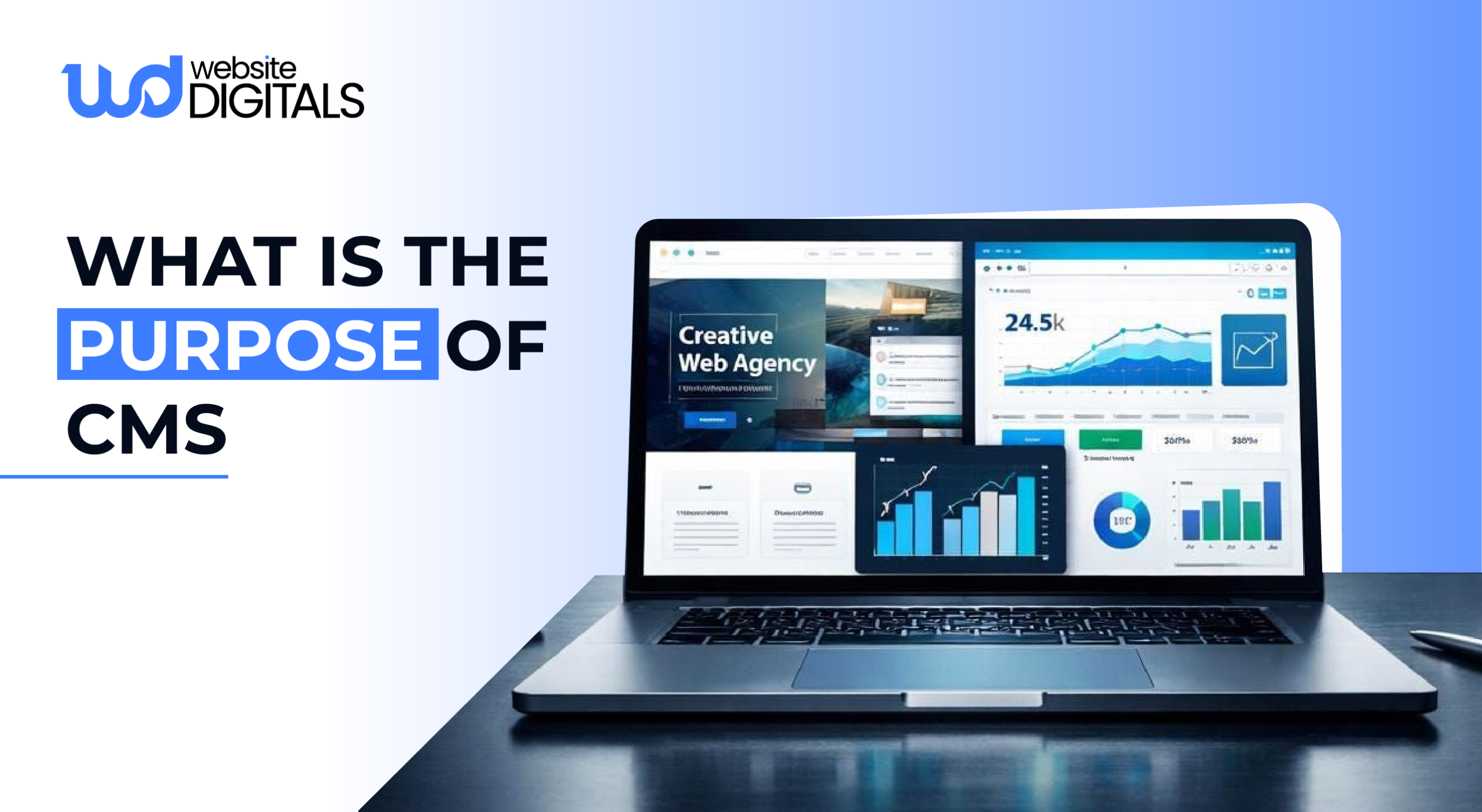
Ask any content manager, “What is the purpose of CMS?” and you’ll probably hear something like, “It’s supposed to make managing the website easier.”
And in theory, that’s true.
But in practice, many modern websites still struggle with:
- Slow publishing cycles
- Approvals scattered across email threads
- And backend tools that feel harder to use than they should.
What’s interesting is that while most websites today rely on a CMS, many teams don’t fully benefit from it because of poor platform choices or inefficient workflows.
In this blog, we’ll break down the real purpose of a CMS, how to use content management system tools effectively, and what businesses should look for to avoid these common pitfalls.
Key Takeaways
|
The Core Purpose Of A CMS In Modern Website Management
The core purpose of a Content Management System (CMS) is to enable non-technical users to create, manage, and modify website content without writing code.
By decoupling content from the technical presentation layer, a CMS centralizes digital assets, streamlines collaborative workflows, and automates responsive design, ensuring a scalable and consistent brand presence.
How A CMS Simplifies Content Creation And Updates
A CMS eliminates the “developer bottleneck.” Instead of waiting for code deployments, marketing and sales teams can update the site in real-time.
- WYSIWYG Editing: Edit text and images in an interface that looks like a word processor.
- Version Control: Track changes and restore previous versions to eliminate the fear of “breaking the site.”
- Centralized Asset Library: A “single source of truth” for images, videos, and PDFs, preventing file chaos.
- Automated Responsiveness: Create content once; the CMS automatically optimizes it for mobile, tablet, and desktop.
Choosing the Right CMS Type
In 2026, the choice depends on your “omnichannel” needs.
|
CMS Type |
Best For |
Example Platforms |
|
Traditional |
Small to mid-size sites, blogs. |
WordPress, Drupal |
|
Headless (API-first) |
Multi-device delivery (App, Web, IoT). |
Contentful, Strapi |
|
DXP (Digital Experience) |
Enterprise-level personalization & ROI. |
Adobe Experience Manager |
|
Cloud-based (SaaS) |
Speed to market & low maintenance. |
Wix Studio, Squarespace |
How A CMS Improves Content Workflows For Teams
-
User Roles And Permissions
A CMS assigns specific roles such as author, editor, or publisher, controlling who can create, review, approve, or publish content.
This prevents accidental changes while allowing multiple contributors to work safely.
-
Structured Publishing Workflows
Content moves through defined stages like draft, review, approval, scheduling, and publication.
Each stage keeps ownership clear and ensures content is reviewed before going live.
-
Content Scheduling
Teams can prepare content in advance and set it to publish automatically at a specific date and time.
This supports coordinated launches, campaigns, and time-zone-based publishing.
-
Content Lifecycle Management
A CMS helps track when content is created, updated, reviewed, or retired.
This makes it easier to identify outdated pages, fill content gaps, and keep the website relevant.
-
Built-In Collaboration Tools
Editors and contributors can leave comments, suggest edits, and track revisions directly inside the CMS.
This reduces reliance on email and keeps feedback tied to the content itself.
The Role Of A CMS In Website Maintenance And Scalability
-
Supports Long-Term Website Growth
A CMS allows websites to scale from dozens of pages to thousands without requiring a full rebuild. Content remains structured and manageable as the site expands.
-
Keeps Content Storage Fast And Organized
Centralized content storage ensures quick retrieval even as volume increases. Most CMS platforms also deliver security updates through simple, one-click installations.
-
Extends Functionality Without Custom Development
Plugins and extensions make it easy to add features like contact forms, SEO tools, or social sharing without writing custom code, allowing sites to evolve as needs change.
-
Maintains Performance As The Site Grows
Built-in performance optimizations such as image compression, caching, and code minification help maintain fast load times at scale.
-
Protects Content With Automated Backups
Regular automated backups ensure quick recovery from errors, updates, or security incidents, reducing downtime and risk.
Real-World Scenario:
|
A growing organization starts with a small Drupal site but later expands to thousands of pages, multiple user roles, and regional content variations. Partnering with a Drupal CMS Development Company allows them to scale securely while maintaining performance and editorial control. |
Types of Content Management Systems (CMS) and When to Use Each
-
Traditional CMS
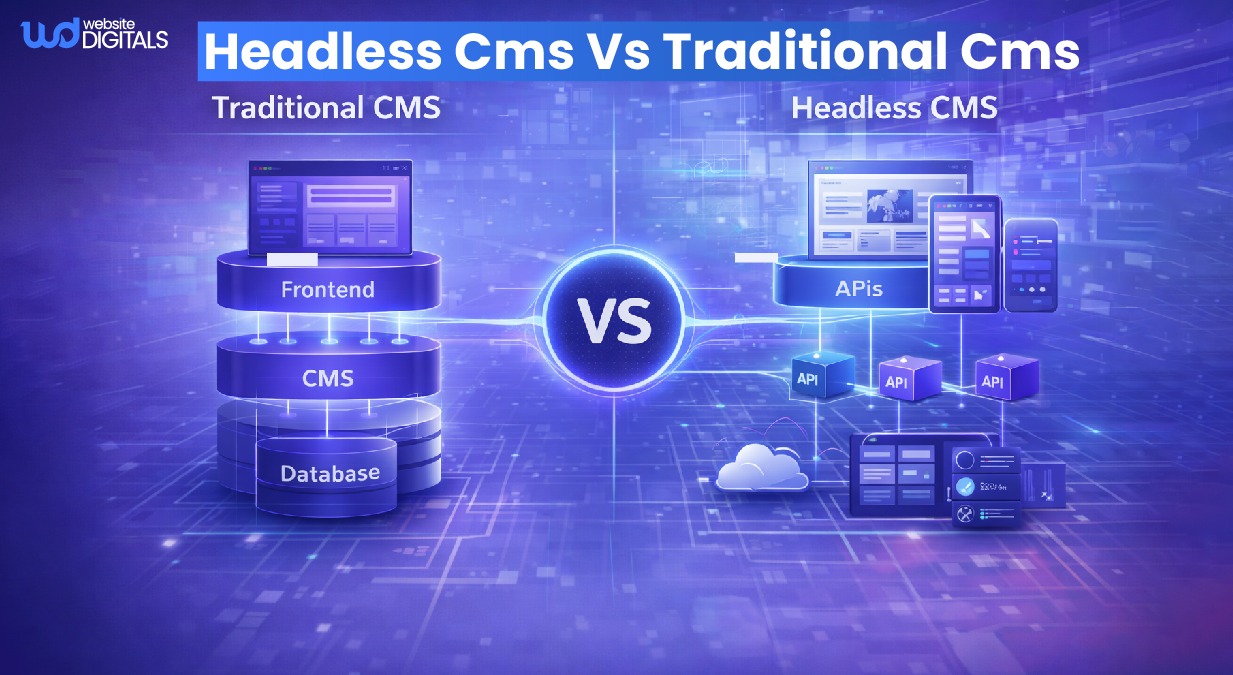
A traditional CMS manages both content and presentation within a single system.
Content is created, stored, and displayed from one platform, making it easy to manage without complex integrations or APIs.
When to use a Traditional CMS:
Use a traditional CMS when your website serves a single primary channel, such as a blog or marketing site, and your team values simplicity, quick setup, and straightforward content management.
-
Headless CMS
A headless CMS separates content from the presentation layer and delivers it through APIs.
This allows content to be reused and distributed across multiple platforms independently of how it is displayed.
When to use a Headless CMS:
Choose a headless CMS if your business delivers content across multiple channels like websites, mobile apps, smart devices, or kiosks, and requires high flexibility and scalability.
-
Decoupled CMS
A decoupled CMS keeps content management centralized while allowing the presentation layer to be customized or replaced.
It offers more flexibility than a traditional CMS without fully separating content delivery.
When to use a Decoupled CMS:
A decoupled CMS works best when you need custom front-end experiences but still want built-in content management features and editorial tools.
-
Cloud-Based CMS
A cloud-based CMS is fully hosted and managed by the provider. Infrastructure, updates, security, and scaling are handled automatically, reducing operational overhead.
When to use a Cloud-Based CMS:
Use a cloud-based CMS if you want fast deployment, minimal maintenance responsibility, and predictable costs without managing servers or infrastructure.
-
Digital Experience Platforms (DXP)
A Digital Experience Platform extends CMS functionality by combining content management with personalization, analytics, and customer experience tools in one ecosystem.
When to use a DXP:
A DXP is best suited for large organizations managing complex digital experiences across multiple customer touchpoints and requiring advanced personalization and data integration.
Choosing the Right CMS Type
Choosing the right CMS depends on how your content is delivered, how your teams work, and how much flexibility your business needs as it grows.
Aligning these factors early, often with guidance from a professional web development agency, helps avoid unnecessary complexity and long-term inefficiencies.
- Content channels: single website vs multi-channel delivery
- Team structure: number of contributors and approval workflows
- Technical capacity: in-house expertise and maintenance resources
- Scalability needs: expected growth in content volume and traffic
- Integration requirements: marketing, analytics, and third-party tools
Real-World Case Study 1:
|
When Domino’s went beyond websites into mobile apps and smart devices, keeping menus and ordering content in sync became critical. Their solution was a decoupled (headless) CMS, which let them update content once and deliver it everywhere, from web to smartwatch, without friction. This setup gave Domino’s the speed and flexibility to launch new digital experiences while keeping content consistent across every customer touchpoint. |
Real-World Case Study 2:
|
Publishing news at scale leaves no room for messy workflows. The New York Times solved this by building Scoop, a custom CMS that allows hundreds of journalists to write, edit, and publish at the same time. With built-in version control and global content management, Scoop keeps stories moving fast while maintaining editorial accuracy, showing how the right CMS can support both speed and control. |
How To Decide If A CMS Is Right For Your Business
To determine if your business requires a Content Management System (CMS), evaluate your operational needs against these four key indicators.
-
Frequency of Content Updates
The most immediate signal is how often your information changes.
If your website management requires weekly or daily updates, such as news cycles, promotional banners, or blog posts, manually editing HTML files becomes unsustainable.
A CMS allows you to push live updates in seconds without a deployment cycle.
-
Multi-Team Content Collaboration
When several team members (Marketing, Sales, Support) need to modify the site, a CMS is essential for coordination.
It provides Role-Based Access Control (RBAC), ensuring a salesperson can update a price list without accidentally breaking the site’s global navigation or header code.
-
Need for Dynamic or Personalized Content
If your site needs to pull information from a database, such as displaying “Related Products,” localized content based on user IP, or member-only portals, static HTML is insufficient.
A CMS handles the complex logic required to serve dynamic content to different visitors automatically.
-
Limited In-House Technical Expertise
For organizations without a dedicated web development team, a CMS is a force multiplier.
It provides a user-friendly interface that empowers non-technical staff to manage a sophisticated web presence.
This reduces “developer dependency” and lowers the long-term total cost of ownership (TCO) for website maintenance.
Pro-Tip: The “Quarterly Rule”
|
As a general benchmark for 2026: If your website changes fewer than four times a year and has under five pages, a Static Site Generator (SSG) or simple HTML may be faster and more secure. However, if you plan to scale, starting with a CMS prevents a painful and expensive migration later. |
Key Factors To Consider When Choosing A CMS
-
Ease of Use and Team Adoption
A CMS should feel intuitive to the people using it daily.
If the interface is confusing, adoption drops, and teams revert to inefficient workarounds.
Always involve real users in demos and trials before making a decision.
Tip:
|
Ask non-technical users to complete basic tasks during a demo; this reveals usability issues quickly. |
-
Content Workflow Alignment
Every team works differently. Some require strict approvals, while others prefer faster, informal collaboration.
Choose a CMS that supports your existing content creation and publishing process instead of forcing new habits.
Note:
|
Workflow flexibility becomes more important as teams grow. |
-
Technical Requirements and Integrations
Consider hosting needs, maintenance effort, security updates, and how the CMS integrates with existing tools like CRM, analytics, or marketing platforms.
Overlooking these factors often leads to unexpected costs later.
Disclaimer:
|
Not all CMS platforms are suitable for every hosting environment or tech stack. |
-
Long-Term Platform Viability
A CMS is a long-term investment. Check whether the platform is actively maintained, has a strong community or vendor support, and continues to evolve with modern web standards.
Note:
|
A large ecosystem usually means better plugins, documentation, and ongoing support. |
-
Total Cost of Ownership
CMS costs go beyond licensing. Hosting, extensions, customization, training, maintenance, and upgrades all contribute to long-term expenses, especially when businesses decide to hire cms development company partners for implementation or scaling.
Tip:
|
Plan costs over a 3–5 year timeline, not just the first year. |
Common CMS Mistakes That Limit Website Efficiency
- Over-customizing everything – Every extra feature adds complexity, increases maintenance costs, and makes future updates harder. Simpler systems scale better.
- Skipping content training – When teams don’t understand CMS features, they fall back on inefficient workarounds and underuse the platform.
- Poor content structure from day one – A confusing information architecture leads to navigation issues that no CMS can magically fix later.
- Ignoring mobile content workflows – If the admin dashboard isn’t usable on tablets or smaller screens, remote and on-the-go teams struggle.
- Installing too many plugins – Each plugin increases security risk and slows performance. Add features only when there’s a clear business need.
- No governance or content standards – Without clear rules for how to use content management systems, inconsistency and confusion quickly follow.
Final Thoughts On The Purpose Of A CMS For Modern Websites
So, what is the purpose of CMS? It’s to make content management simpler, scalable, and sustainable as your website grows.
A well-implemented CMS removes technical barriers, supports collaboration, and keeps content workflows efficient.
If you’re moving beyond basic website management and planning CMS development or migration, choosing the right system matters.
Our experts at Website Digitals can help you build or customize a CMS that fits your business. Reach us at info@websitedigitals.com or connect through call (646)-222-3598 to get started.
FAQs
1 How does Website Digitals help businesses choose the right CMS?
Website Digitals evaluates your business goals, content workflows, and technical constraints before recommending a CMS. This ensures the platform supports your team’s day-to-day content management while remaining scalable as your website grows.
2 Can Website Digitals customize or migrate existing CMS platforms?
Yes. Website Digitals handles CMS customization, migration, and optimization, helping businesses improve performance, streamline content workflows, and avoid disruptions during transitions.
3 What is the purpose of CMS in modern websites?
The purpose of a CMS is to allow non-technical users to create, edit, manage, and publish website content without writing code. It centralizes content and simplifies ongoing website management.
4 What does a content management system do?
A content management system stores digital content in a central database and provides tools to create, edit, publish, and organize that content through an easy-to-use admin interface.
5 Why is CMS important for businesses?
CMS is important because it improves efficiency, reduces reliance on developers, supports collaboration, and allows businesses to update content quickly while maintaining consistency.
6 How CMS work behind the scenes?
A CMS works by separating content from design. Users manage content through an admin dashboard, while the system dynamically delivers that content to the website using templates or APIs.